For the equilibrium Br2(π) + Cl2(π) β 2 BrCl(π) at 400 K, πΎπ = 7.0. If 0.25 mol of Br2 and 0.55 mol of Cl2 are introduced into a 3.0-L container at 400 K, what will be the equilibrium concentrations of Br2, Cl2, and BrCl?
Ch.15 - Chemical Equilibrium
Brown14th EditionChemistry: The Central ScienceISBN: 9780134414232Not the one you use?Change textbook
Chapter 15, Problem 53
At 373 K, πΎπ = 0.416 for the equilibrium 2 NOBr(π) β 2 NO(π) + Br2(π) If the pressures of NOBr(π) and NO(π) are equal, what is the equilibrium pressure of Br2(π)?
Verified step by step guidance1
Identify the balanced chemical equation: 2 NOBr(g) β 2 NO(g) + Br_2(g).
Write the expression for the equilibrium constant K_p: K_p = (P_NO^2 * P_Br2) / (P_NOBr^2).
Since the pressures of NOBr and NO are equal, let P_NOBr = P_NO = x.
Substitute the pressures into the K_p expression: 0.416 = (x^2 * P_Br2) / (x^2).
Solve for P_Br2: P_Br2 = 0.416.

Verified video answer for a similar problem:
This video solution was recommended by our tutors as helpful for the problem above.
Video duration:
2mWas this helpful?
Key Concepts
Here are the essential concepts you must grasp in order to answer the question correctly.
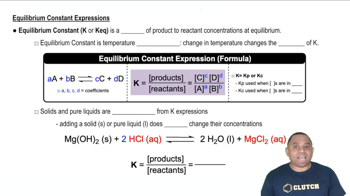
Equilibrium Constant (Kp)
The equilibrium constant, Kp, is a ratio that expresses the relationship between the partial pressures of the products and reactants at equilibrium for a given reaction at a specific temperature. For the reaction 2 NOBr(g) β 2 NO(g) + Br2(g), Kp is calculated using the formula Kp = (P_NO^2 * P_Br2) / (P_NOBr^2), where P represents the partial pressures of the gases involved.
Recommended video:
Guided course
Equilibrium Constant Expressions
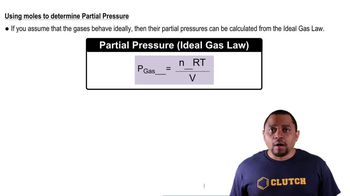
Partial Pressure
Partial pressure is the pressure exerted by a single component of a gas mixture. In the context of the equilibrium reaction, the total pressure is the sum of the partial pressures of NOBr, NO, and Br2. Understanding how to calculate and relate these pressures is essential for determining the equilibrium state of the system.
Recommended video:
Guided course
Partial Pressure Calculation
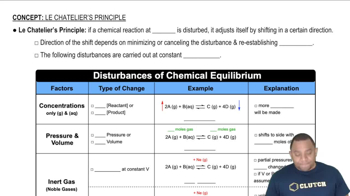
Le Chatelier's Principle
Le Chatelier's Principle states that if a dynamic equilibrium is disturbed by changing the conditions, the system will adjust to counteract the change and restore a new equilibrium. In this problem, if the pressures of NOBr and NO are equal, the system will shift to produce more Br2 to maintain the equilibrium constant, which is crucial for finding the equilibrium pressure of Br2.
Recommended video:
Guided course
Le Chatelier's Principle
Related Practice
Textbook Question
1
views
Textbook Question
At 80Β°C, πΎπ = 1.87Γ10β3 for the reaction PH3BCl3(π ) β PH3(π) + BCl3(π) (a) Calculate the equilibrium concentrations of PH3 and BCl3 if a solid sample of PH3BCl3 is placed in a closed vessel at 80Β°C and decomposes until equilibrium is reached.
Textbook Question
At 218Β°C, πΎπ = 1.2Γ10β4 for the equilibrium NH4SH(π ) β NH3(π) + H2S(π) Calculate the equilibrium concentrations of NH3 and H2S if a sample of solid NH4SH is placed in a closed vessel at 218Β°C and decomposes until equilibrium is reached.
Textbook Question
At 2000Β°C, the equilibrium constant for the reaction 2 NO(π) β N2(π) + O2(π) is πΎπ = 2.4Γ103. If the initial concentration of NO is 0.175 M, what are the equilibrium concentrations of NO, N2, and O2?
1
views