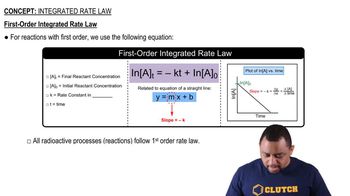
Americium-241 is used in smoke detectors. It has a first-order rate constant for radioactive decay of k = 1.6 * 10-3 yr-1. By contrast, iodine-125, which is used to test for thyroid functioning, has a rate constant for radioactive decay of k = 0.011 day-1. (a) What are the half-lives of these two isotopes? (b) Which one decays at a faster rate?
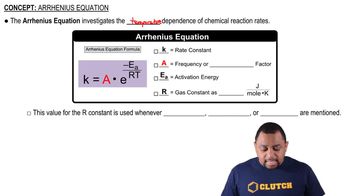
The reaction H₂O₂(aq) → H₂O(l) + 1/2 O₂(g) is first order. At 300 K, the rate constant equals 7.0 * 10⁻⁴ s⁻¹. If the activation energy for this reaction is 75 kJ/mol, at what temperature would the reaction rate be doubled?
Verified step by step guidanceKey Concepts
First-Order Reactions
Arrhenius Equation
Doubling the Reaction Rate
Americium-241 is used in smoke detectors. It has a first-order rate constant for radioactive decay of k = 1.6 * 10-3 yr-1. By contrast, iodine-125, which is used to test for thyroid functioning, has a rate constant for radioactive decay of k = 0.011 day-1. (c) How much of a 1.00-mg sample of each isotope remains after three half-lives? (d) How much of a 1.00-mg sample of each isotope remains after 4 days?
Consider two reactions. Reaction (1) has a constant halflife, whereas reaction (2) has a half-life that gets longer as the reaction proceeds. What can you conclude about the rate laws of these reactions from these observations?
The reaction 2 NO2 → 2 NO + O2 has the rate constant k = 0.63 M-1s-1.
(b) If the initial concentration of NO2 is 0.100 M, how would you determine how long it would take for the concentration to decrease to 0.025 M?
