The following diagrams represent mixtures of NO(g) and O21g2. These two substances react as follows: 2 NO1g2 + O21g2¡2 NO21g2 It has been determined experimentally that the rate is second order in NO and first order in O2. Based on this fact, which of the following mixtures will have the fastest initial rate? [Section 14.3]
Ch.14 - Chemical Kinetics
Brown14th EditionChemistry: The Central ScienceISBN: 9780134414232Not the one you use?Change textbook
Chapter 14, Problem 4b
Suppose that for the reaction K + L → M, you monitor the production of M over time, and then plot the following graph from your data:

(b) Is the reaction completed at t = 15 min? [Section 14.2]
Verified step by step guidance1
Observe the graph showing the concentration of M over time.
Note that the concentration of M increases linearly from 0 to 30 minutes.
At 30 minutes, the concentration of M levels off and remains constant.
Determine if the reaction is complete by checking if the concentration of M changes after 15 minutes.
Since the concentration of M continues to increase after 15 minutes and only levels off at 30 minutes, the reaction is not complete at t = 15 min.

Verified video answer for a similar problem:
This video solution was recommended by our tutors as helpful for the problem above.
Video duration:
55sWas this helpful?
Key Concepts
Here are the essential concepts you must grasp in order to answer the question correctly.
Reaction Completion
A chemical reaction is considered complete when the concentration of the products no longer changes over time. In the context of the provided graph, this means that if the concentration of M remains constant after a certain time, the reaction has reached completion.
Recommended video:
Guided course
Complete Ionic Equations
Rate of Reaction
The rate of a chemical reaction refers to how quickly reactants are converted into products. This can be observed in the graph as the slope of the line representing the concentration of M over time. A steeper slope indicates a faster reaction rate, while a flat line indicates that the reaction has slowed or stopped.
Recommended video:
Guided course
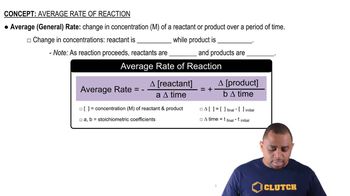
Average Rate of Reaction
Equilibrium
Chemical equilibrium occurs when the rates of the forward and reverse reactions are equal, resulting in constant concentrations of reactants and products. In the graph, if the concentration of M stabilizes at a certain level, it suggests that the system may have reached equilibrium, indicating that the reaction is no longer proceeding in either direction.
Recommended video:
Guided course
Thermal Equilibrium
Related Practice
Textbook Question
Textbook Question
You study the rate of a reaction, measuring both the concentration of the reactant and the concentration of the product as a function of time, and obtain the following results:
Which chemical equation is consistent with these data: (i) A → B, (ii) B → A, (iii) A → 2 B, (iv) B → 2 A?
Textbook Question
Consider the following graph of the concentration of a substance X over time. Is each of the following statements true or false? (d) As time progresses, the curve will eventually turn downward toward the x-axis. [Section 14.2]
1
views
Textbook Question
Given the following diagrams at t = 0 min and t = 30 min
After four half-life periods for a first-order reaction, what fraction of reactant remains? [Section 14.4]
