
Textbook Question
(c) Do catalysts affect the overall enthalpy change for a reaction, the activation energy, or both?
 Verified step by step guidance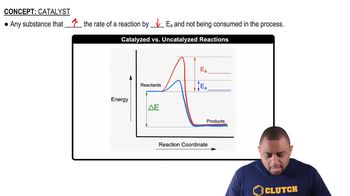
 01:59
01:59
 03:06
03:06(c) Do catalysts affect the overall enthalpy change for a reaction, the activation energy, or both?
(a) What is a catalyst? (b) What is the difference between a homogeneous and a heterogeneous catalyst?
(a) Most commercial heterogeneous catalysts are extremely finely divided solid materials. Why is particle size important?
You have studied the gas-phase oxidation of HBr by O2: 4 HBr(g) + O2(g) → 2 H2O(g) + 2 Br2(g)
You find the reaction to be first order with respect to HBr and first order with respect to O2. You propose the following mechanism:
HBr(g) + O2(g) → HOOBr(g)
HOOBr(g) + HBr(g) → 2 HOBr(g)
HOBr(g) + HBr(g) → H2O(g) + Br2(g)
(b) Based on the experimentally determined rate law, which step is rate determining?