
(a) Place the following substances in order of increasing volatility: CH4, CBr4, CH2Cl2, CH3Cl, CHBr3, and CH2Br2. (b) How do the boiling points vary through this series? (c) Explain your answer to part (b) in terms of intermolecular forces.
Ch.11 - Liquids and Intermolecular Forces
Brown14th EditionChemistry: The Central ScienceISBN: 9780134414232Not the one you use?Change textbook
Chapter 11, Problem 49
Which of the following affects the vapor pressure of a liquid? (a) Volume of the liquid, (b) surface area, (c) intermolecular attractive forces, (d) temperature, (e) density of the liquid
Verified step by step guidance1
Step 1: Understand that vapor pressure is the pressure exerted by a vapor in equilibrium with its liquid phase at a given temperature.
Step 2: Recognize that vapor pressure is primarily influenced by the temperature of the liquid. As temperature increases, the kinetic energy of the molecules increases, leading to a higher vapor pressure.
Step 3: Consider the role of intermolecular attractive forces. Stronger intermolecular forces (e.g., hydrogen bonding) result in lower vapor pressure because more energy is required for molecules to escape into the vapor phase.
Step 4: Note that the volume of the liquid and the surface area do not affect vapor pressure. Vapor pressure is an intensive property, meaning it does not depend on the amount of liquid or the surface area.
Step 5: Understand that the density of the liquid does not directly affect vapor pressure. Density is related to mass and volume, but vapor pressure is determined by the temperature and intermolecular forces.
Key Concepts
Here are the essential concepts you must grasp in order to answer the question correctly.
Vapor Pressure
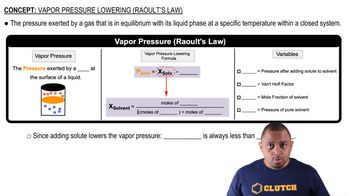
Vapor pressure is the pressure exerted by a vapor in equilibrium with its liquid or solid phase at a given temperature. It reflects the tendency of molecules to escape from the liquid into the vapor phase. Higher vapor pressure indicates a greater number of molecules in the vapor phase, which is influenced by temperature and intermolecular forces.
Recommended video:
Guided course
Raoult's Law and Vapor Pressure
Intermolecular Forces
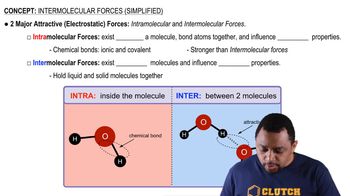
Intermolecular forces are the attractive forces between molecules that influence physical properties such as boiling point and vapor pressure. Stronger intermolecular forces result in lower vapor pressure because they hold the molecules in the liquid phase more tightly, making it harder for them to escape into the vapor phase.
Recommended video:
Guided course
Intermolecular vs Intramolecular Forces
Temperature
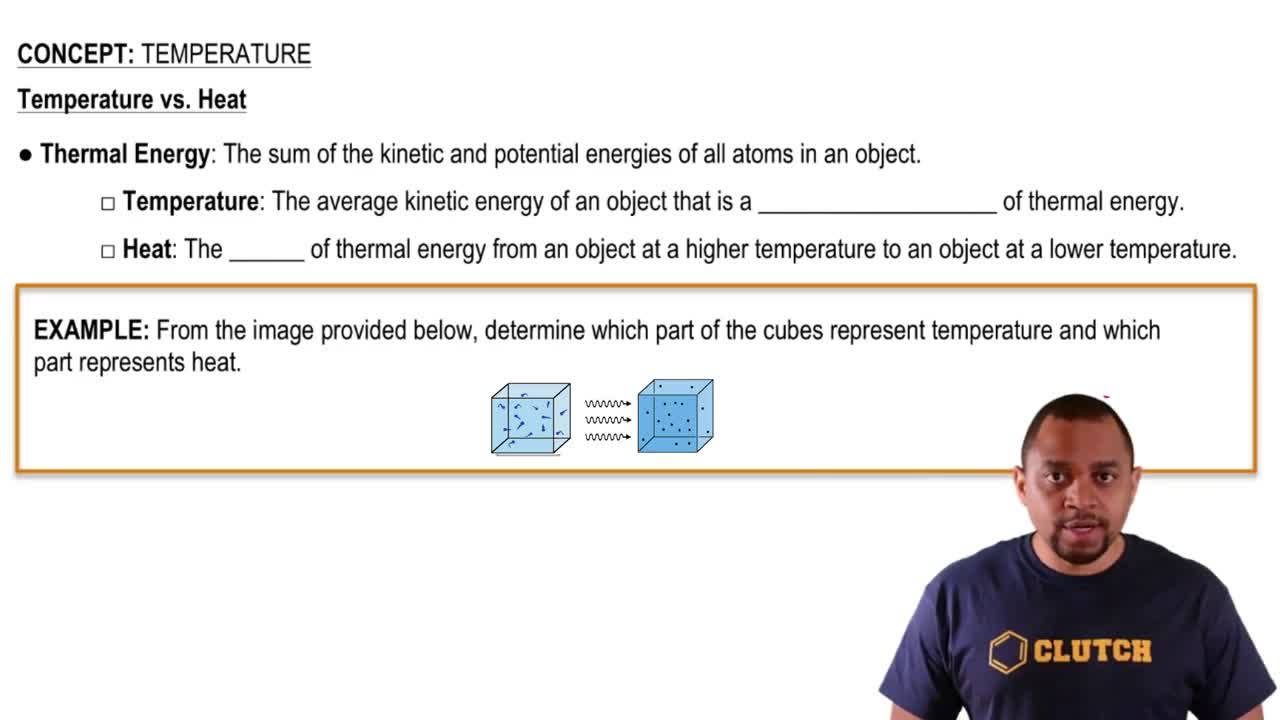
Temperature is a measure of the average kinetic energy of molecules in a substance. As temperature increases, the kinetic energy of the molecules also increases, leading to a higher rate of evaporation and, consequently, an increase in vapor pressure. This relationship is described by the Clausius-Clapeyron equation, which quantifies how vapor pressure changes with temperature.
Recommended video:
Guided course
Temperature vs Heat
Related Practice
Textbook Question
Textbook Question
The critical temperatures and pressures of a series of halogenated methanes are as follows: (c) Predict the critical temperature and pressure for CCl4 based on the trends in this table. Look up the experimentally determined critical temperatures and pressures for CCl4, using a source such as the CRC Handbook of Chemistry and Physics, and suggest a reason for any discrepancies.
Textbook Question
The critical temperatures and pressures of a series of halogenated methanes are as follows:
(a) List the intermolecular forces that occur for each compound.
