Chlorine is widely used to purify municipal water supplies and to treat swimming pool waters. Suppose that the volume of a particular sample of Cl2 gas is 8.70 L at 119.3 kPa and 24 °C. (b) What volume will the Cl2 occupy at STP?

Ch.10 - Gases
Brown14th EditionChemistry: The Central ScienceISBN: 9780134414232Not the one you use?Change textbook
Chapter 10, Problem 41
A 50.0 g sample of solid CO2 (dry ice) is added at -100 °C toan evacuated (all of the gas removed) container with a volumeof 5.0 L. If the container is sealed and then allowed to warmto room temperature 125 °C2 so that the entire solid CO2 isconverted to a gas, what is the pressure inside the container?
Verified step by step guidance1
Identify the initial and final conditions of the system. Initially, you have solid CO2 at -100 °C, and finally, you have gaseous CO2 at 25 °C in a 5.0 L container.
Convert the mass of CO2 to moles using the molar mass of CO2 (44.01 g/mol). This will help you determine the amount of gas present.
Use the Ideal Gas Law, \( PV = nRT \), to find the pressure. Here, \( P \) is the pressure, \( V \) is the volume (5.0 L), \( n \) is the number of moles of CO2, \( R \) is the ideal gas constant (0.0821 L·atm/mol·K), and \( T \) is the temperature in Kelvin.
Convert the final temperature from Celsius to Kelvin by adding 273.15 to the Celsius temperature (25 °C).
Substitute the values for \( n \), \( V \), \( R \), and \( T \) into the Ideal Gas Law equation and solve for \( P \), the pressure inside the container.

Verified video answer for a similar problem:
This video solution was recommended by our tutors as helpful for the problem above.
Video duration:
4mWas this helpful?
Key Concepts
Here are the essential concepts you must grasp in order to answer the question correctly.
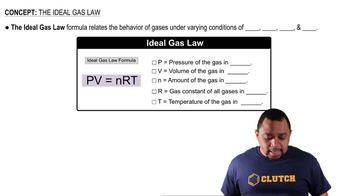
Ideal Gas Law
The Ideal Gas Law is a fundamental equation in chemistry that relates the pressure, volume, temperature, and number of moles of a gas. It is expressed as PV = nRT, where P is pressure, V is volume, n is the number of moles, R is the ideal gas constant, and T is temperature in Kelvin. This law is essential for calculating the pressure of gases under varying conditions.
Recommended video:
Guided course
Ideal Gas Law Formula
Molar Mass and Moles
Molar mass is the mass of one mole of a substance, typically expressed in grams per mole (g/mol). To find the number of moles of a substance, you can use the formula n = mass (g) / molar mass (g/mol). In this question, knowing the molar mass of CO2 allows us to convert the mass of dry ice into moles, which is necessary for applying the Ideal Gas Law.
Recommended video:
Guided course
Molar Mass Concept
Phase Changes and Temperature Effects
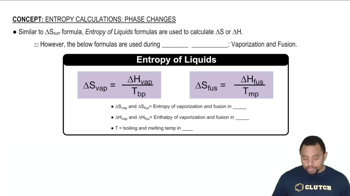
Phase changes refer to the transitions between solid, liquid, and gas states of matter, which are influenced by temperature and pressure. In this scenario, solid CO2 (dry ice) sublimates directly into gas as it warms up. Understanding how temperature affects the state of a substance is crucial for predicting the behavior of CO2 in the container as it transitions from solid to gas.
Recommended video:
Guided course
Entropy in Phase Changes
Related Practice
Textbook Question
Textbook Question
An aerosol spray can with a volume of 125 mL contains 1.30 g of propane gas (C3H8) as a propellant. (a) If the can is at 25 °C, what is the pressure in the can?
Textbook Question
A scuba diver's tank contains 2.50 kg of O2 compressed intoa volume of 11.0 L. (b) What volume would this oxygen occupy at25 °C and 101.33 kPa?
Textbook Question
Chlorine is widely used to purify municipal water supplies and to treat swimming pool waters. Suppose that the volume of a particular sample of Cl2 gas is 8.70 L at 119.3 kPa and 24 °C. (c) At what temperature will the volume be 15.00 L if the pressure is 116.8 kPa
Textbook Question
A 334-mL cylinder for use in chemistry lectures contains5.225 g of helium at 23 °C. How many grams of helium mustbe released to reduce the pressure to 7.60 MPa assuming idealgas behavior?
Textbook Question
An aerosol spray can with a volume of 125 mL contains 1.30 g of propane gas (C3H8) as a propellant. (c) The can's label says that exposure to temperatures above 50 °C may cause the can to burst. What is the pressure in the can at this temperature?