 Back
BackQuantum Mechanics - General Chemistry
 03:37
03:37
Terms in this set (23)
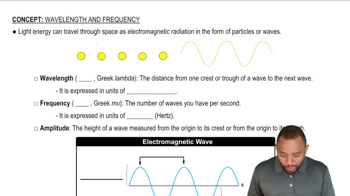
Wavelength (λ) is the distance from one crest or trough of a wave to the next, expressed in units of length such as meters or nanometers.
Frequency (ν) is the number of waves that pass a point per second, measured in Hertz (Hz).
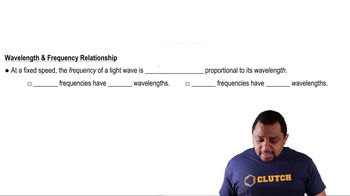
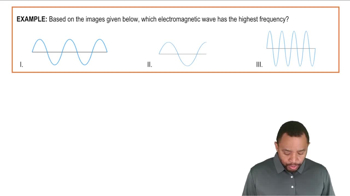
Frequency is inversely proportional to wavelength; higher frequencies have shorter wavelengths and lower frequencies have longer wavelengths.
The speed of light is a constant 3.00 x 10⁸ m/s and is related by the formula \(c=\lambda \nu\).
A photon is a particle or packet of electromagnetic radiation that carries energy proportional to its frequency.
Planck's constant (h) is 6.626 x 10⁻³⁴ J·s, used to calculate photon energy.
Energy is calculated by \(E=h\nu\), where E is energy, h is Planck's constant, and ν is frequency.
Energy is calculated by \(E=\frac{hc}{\lambda}\), where λ is wavelength.
The electromagnetic spectrum is the continuum of all electromagnetic radiation wavelengths and frequencies, from radio waves to gamma rays.
Wavelengths decrease and frequencies increase moving from radio waves to gamma rays.
The photoelectric effect occurs when photons with energy above a metal's binding energy eject electrons from the surface.
Binding energy is the minimum energy required to eject an electron from a metal, also called the work function.
\(E_{photon} = E_{B.E.} + E_{K.E.}\), where photon energy equals binding energy plus kinetic energy of ejected electrons.
The de Broglie wavelength associates wave properties to particles, calculated by \(\lambda=\frac{h}{mv}\).
It states that the position and momentum of an electron cannot be simultaneously measured with perfect accuracy.
Principal quantum number (n) indicates the energy level or shell of an electron, with values from 1 to 7.
Angular momentum quantum number (l) defines the subshell shape, with values from 0 to n-1.
Magnetic quantum number (ml) specifies the orientation of orbitals within a subshell, ranging from –l to +l.
Spin quantum number (ms) describes electron spin, with values +1/2 (up) or –1/2 (down).
An orbital can hold a maximum of 2 electrons with opposite spins.
An emission spectrum is a series of discrete lines formed when electrons emit energy moving from higher to lower shells.
The Bohr equation calculates the energy change when an electron transitions between two energy levels.
A node is a region where the probability of finding an electron is zero; total nodes = n – 1.