 Back
BackGeneral Chemistry: Matter and Measurements
 01:34
01:34

Terms in this set (13)
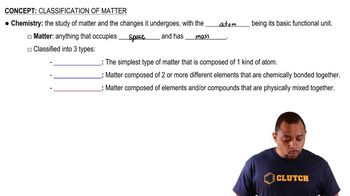
Matter is anything that has mass and occupies space.
The three states of matter are solid, liquid, and gas.
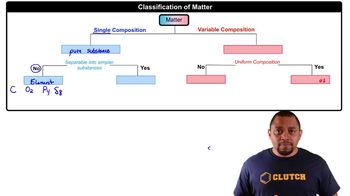
A pure substance has a fixed composition and cannot be separated by physical means.
An element is a pure substance that cannot be broken down by chemical means.
A compound is made of two or more elements chemically combined, like water (H\(2\)O) or carbon dioxide (CO\(2\)).
Elements are organized by increasing atomic number in the periodic table.
Atoms contain protons, neutrons, and electrons.
Protons and neutrons are in the nucleus; electrons orbit the nucleus.
An ionic bond forms when electrons transfer between a metal and a nonmetal.
A covalent bond forms when atoms share pairs of electrons.
Length: meter, mass: kilogram, time: second, temperature: kelvin, amount of substance: mole.
Significant figures express the precision of a measurement.
Density equals mass divided by volume: \(d=\frac{m}{V}\).