 Back
BackGeneral Chemistry: Introductory Concepts and Measurements
 01:34
01:34

Terms in this set (23)
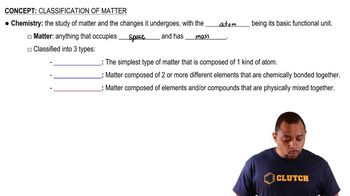
Chemistry is the study of matter and the changes it undergoes, with the atom being its basic functional unit.
Matter is anything that occupies space and has mass.
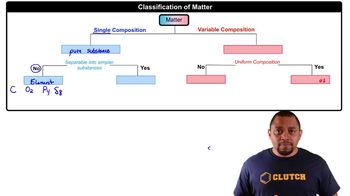
1. Element: simplest type of matter composed of one kind of atom.
2. Compound: matter composed of two or more different elements chemically bonded.
3. Mixture: matter composed of elements and/or compounds physically mixed.
A physical change is a change in the physical state of a substance without changing its composition.
A chemical change involves a change in chemical composition, creating new chemical bonds and products.
Reversible changes can be undone to restore the original structure (e.g., phase changes).
Irreversible changes are permanent and cannot be undone (e.g., burning).
A chemical property is observed during a chemical reaction and results in a new substance.
A physical property is a measurable property describing the state of a substance without changing its chemical structure.
Intensive properties do not depend on the amount of substance present and are characteristic properties (e.g., melting point, density).
Extensive properties depend on the amount of substance present (e.g., mass, volume).
Temperature is the average kinetic energy of particles in an object and a measure of thermal energy.
Heat is the transfer of thermal energy from an object at higher temperature to one at lower temperature.
Temperature is measured in degrees Celsius (ºC), degrees Fahrenheit (ºF), and Kelvin (K).
Scientific notation expresses very large or small numbers as a coefficient (≥1 and <10) multiplied by 10 raised to an integer exponent.
The SI base units include meter (length), kilogram (mass), second (time), kelvin (temperature), mole (amount of substance), ampere (electric current), and candela (luminous intensity).
Metric prefixes modify base units by powers of ten, such as kilo (10³), centi (10⁻²), and micro (10⁻⁶).
Significant figures are digits in a number that contribute to its precision, including all non-zero digits and certain zeros depending on position.
The result should have the same number of significant figures as the factor with the least significant figures.
The result should have the same number of decimal places as the number with the least decimal places.
A conversion factor is a ratio that relates two different units and is used to convert between them.
Dimensional analysis is a method to convert units by multiplying by conversion factors to cancel unwanted units and isolate desired units.
Density is the amount of mass per unit volume, commonly expressed in g/cm³ for solids and liquids, and g/L for gases.
Water displacement measures the volume of an irregular object by the amount of water it displaces when submerged.