 Back
BackGeneral Chemistry Fundamentals
 01:34
01:34

Terms in this set (20)
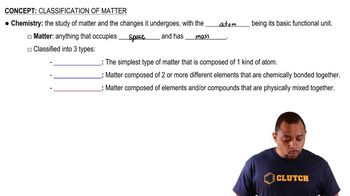
Matter is anything that has mass and occupies space.
The three states of matter are solid, liquid, and gas.
An atom is the smallest unit of an element that retains its chemical properties.
Protons, neutrons, and electrons are the main subatomic particles.
The atomic number is the number of protons in the nucleus of an atom.
The periodic table organizes elements by increasing atomic number and groups with similar properties.
An ionic bond forms when electrons are transferred from one atom to another, creating ions.
A covalent bond forms when atoms share electrons.
A cation is a positively charged ion; an anion is a negatively charged ion.
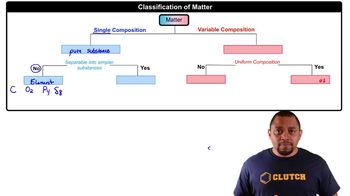
An element contains only one type of atom; a compound contains two or more different atoms chemically bonded.
A mole is the amount of substance containing \(6.022\times10^{23}\) entities (Avogadro's number).
An amu is 1/12 the mass of a carbon-12 atom, used to express atomic and molecular masses.
Mass number is protons plus neutrons; atomic number is protons only.
Isotopes are atoms of the same element with different numbers of neutrons.
Elements are arranged in periods (rows) by increasing atomic number and groups (columns) by similar chemical properties.
Metals are good conductors and malleable; nonmetals are poor conductors; metalloids have properties of both.
Molar mass is the mass of one mole of a substance, expressed in grams per mole (g/mol).
The law of conservation of mass states mass is neither created nor destroyed in a chemical reaction.
An empirical formula shows the simplest ratio of atoms; a molecular formula shows the actual number of atoms.
The octet rule states atoms tend to gain, lose, or share electrons to have eight valence electrons.