 Back
BackGeneral Chemistry Fundamentals
 01:34
01:34

Terms in this set (20)
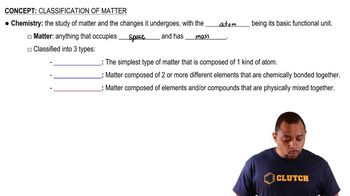
Matter is anything that has mass and occupies space.
The three states of matter are solid, liquid, and gas.
An atom is the smallest unit of an element that retains its chemical properties.
Protons, neutrons, and electrons are the main subatomic particles.
A proton has a positive charge and is located in the nucleus.
A neutron has no charge (neutral) and is located in the nucleus.
An electron has a negative charge and orbits the nucleus in electron clouds.
The atomic number is the number of protons in an atom's nucleus.
The mass number is the total number of protons and neutrons in the nucleus.
Isotopes are atoms of the same element with different numbers of neutrons.
The periodic table organizes elements by increasing atomic number and similar chemical properties.
A group is a vertical column of elements with similar valence electron configurations and properties.
A period is a horizontal row of elements with increasing atomic number.
An ionic bond forms when electrons are transferred from one atom to another, creating oppositely charged ions.
A covalent bond forms when atoms share electrons to achieve stable electron configurations.
The octet rule states atoms tend to gain, lose, or share electrons to have eight electrons in their valence shell.
Metals tend to form ionic bonds with nonmetals by losing electrons, while nonmetals form covalent bonds by sharing electrons.
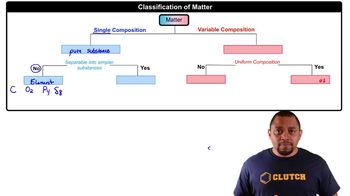
An element contains only one type of atom; a compound contains two or more different atoms chemically bonded.
A molecule is two or more atoms covalently bonded together.
Valence electrons determine an atom's chemical reactivity and bonding behavior.