Skip to main content
General Chemistry
My Course
Learn
Exam Prep
AI Tutor
Study Guides
Textbook Solutions
Flashcards
Explore
Try the app
My Course
Learn
Exam Prep
AI Tutor
Study Guides
Textbook Solutions
Flashcards
Explore
Try the app
Back
General Chemistry Fundamentals
You can tap to flip the card.
What does the atomic number represent?
You can tap to flip the card.
👆
What does the atomic number represent?
The
atomic number
is the number of protons in an atom's nucleus.
Track progress
Control buttons has been changed to "navigation" mode.
1/19
Recommended videos
Guided course
02:53
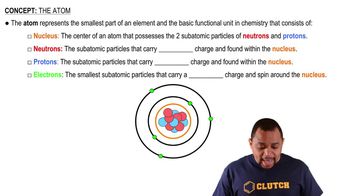
The Nucleus
148
views
Guided course
02:10
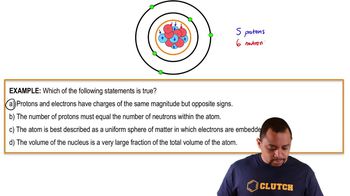
Atom Structure
368
views
14
rank
Guided course
02:52
Atom Structure Example
181
views
7
rank
Terms in this set (19)
Hide definitions
What does the atomic number represent?
The
atomic number
is the number of protons in an atom's nucleus.
What is the mass number of an atom?
The
mass number
is the total number of protons and neutrons in the nucleus.
Name the three main types of chemical bonds.
The three main types are
ionic
,
covalent
, and
metallic
bonds.
How do ionic bonds form?
Ionic bonds form by the
transfer of electrons
from one atom to another, creating ions.
What characterizes covalent bonds?
Covalent bonds involve the
sharing of electron pairs
between atoms.
What is a metallic bond?
A metallic bond is the
sharing of free electrons
among a lattice of metal atoms.
List key periodic table trends.
Important trends include
electronegativity
,
atomic radius
,
ionization energy
, and
reactivity
.
What is electronegativity?
Electronegativity
is an atom's ability to attract electrons in a chemical bond.
How does atomic radius change across a period?
Atomic radius
decreases
from left to right across a period due to increasing nuclear charge.
What happens to ionization energy across a period?
Ionization energy generally
increases
from left to right across a period.
Define ionization energy.
Ionization energy is the energy required to
remove an electron
from an atom.
What is a chemical reaction?
A chemical reaction involves the
rearrangement of atoms
to form new substances.
What are reactants and products?
Reactants
are substances before a reaction;
products
are substances formed after the reaction.
Why balance chemical equations?
Balancing ensures the
law of conservation of mass
is obeyed; atoms are equal on both sides.
Name common types of chemical reactions.
Common types include
synthesis
,
decomposition
,
single replacement
, and
double replacement
.
What is a synthesis reaction?
A synthesis reaction combines two or more reactants to form a
single product
.
Describe a decomposition reaction.
A decomposition reaction breaks down a compound into
two or more simpler substances
.
What occurs in a single replacement reaction?
One element replaces another in a compound, producing a new element and compound.
What is a double replacement reaction?
Two compounds exchange ions to form two new compounds.
 BackBack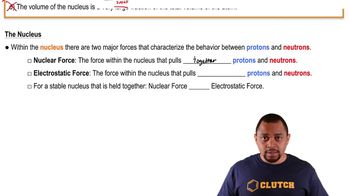
 02:53
02:53