 Back
BackGeneral Chemistry: Energy, Thermodynamics, and Calorimetry
 01:59
01:59
Terms in this set (20)
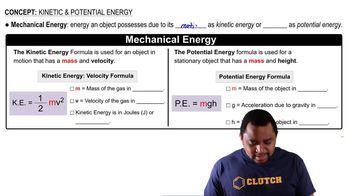
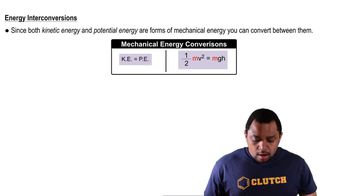
Kinetic energy is the energy associated with the motion of an object.
Potential energy is the energy associated with the position or arrangement of an object.
ΔE = q + w, where both q (heat) and w (work) are negative because the system loses heat and does work on the surroundings.
q is positive if heat is absorbed by the system, negative if released; w is positive if work is done on the system, negative if done by the system.
Use the formula \(q = m c \Delta T\) and rearrange to \(c = \frac{q}{m \Delta T}\).
59.3 kJ = 59300 J (since 1 kJ = 1000 J).
ΔT = 398 K - 298 K = 100 K.
Moles = mass / molar mass; for ethanol, moles = 21.8 g / 46.07 g/mol.
Heat released = moles × ΔH°rxn (use correct sign and units).
Heat absorbed by calorimeter = heat released by reaction; use \(q = C \Delta T\) and solve for C.
Moles = 612 g / 137.32 g/mol.
Reaction equivalents = moles of PCl3 / 4 (since 4 moles PCl3 per reaction).
Energy required = reaction equivalents × ΔH°rxn (where ΔH°rxn = +1207 kJ).
ΔE = q + w, where ΔE is change in internal energy, q is heat, and w is work.
A negative q means the system is releasing heat to the surroundings.
A negative w means the system is doing work on the surroundings.
The molar mass of ethanol is 46.07 g/mol.
ΔH°rxn = -1235 kJ for the combustion of ethanol.
C2H5OH(l) + 3 O2(g) → 2 CO2(g) + 3 H2O(g)
4 PCl3(g) → P4(s) + 6 Cl2(g)