 Back
BackGeneral Chemistry: Energy, Thermodynamics, and Calorimetry
 01:59
01:59
Terms in this set (20)
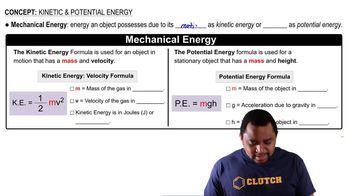
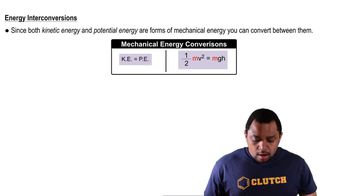
Kinetic energy is the energy associated with the motion of an object.
Potential energy is the energy associated with the position or arrangement of an object.
\(\Delta E = q + w\), where both \(q\) (heat) and \(w\) (work) are negative since the system loses heat and does work.
Heat lost by the system: \(q < 0\). Work done by the system: \(w < 0\).
\(q = m c \Delta T\)
\(c = \frac{q}{m \Delta T}\)
59.3 kJ = 59300 J (since 1 kJ = 1000 J).
\(\Delta T = 398 - 298 = 100\ K\)
\(\text{moles} = \frac{\text{mass}}{\text{molar mass}}\)
\(\frac{21.8}{46.07} \approx 0.473\ mol\)
\(q = \text{moles} \times \Delta H^{\circ}_{rxn}\)
Heat absorbed by calorimeter equals the negative of heat released by the reaction: \(q_{cal} = -q_{rxn}\).
\(q_{cal} = C_{cal} \Delta T\)
\(C_{cal} = \frac{q_{cal}}{\Delta T}\)
\(\frac{612}{137.32} \approx 4.46\ mol\)
Reaction equivalents = \(\frac{\text{moles of PCl3}}{4}\)
\(\text{Energy} = \text{reaction equivalents} \times \Delta H^{\circ}_{rxn}\)
\(+1207\ kJ\) per 4 moles of PCl3 decomposed.
A positive ΔH°rxn means the reaction is endothermic, absorbing energy.
A negative ΔH°rxn means the reaction is exothermic, releasing energy.