 Back
BackGeneral Chemistry: Atomic Structure Basics
 02:53
02:53
Terms in this set (20)
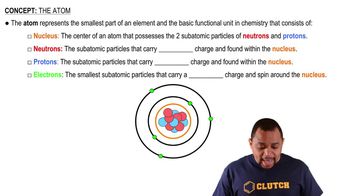
An atom is the smallest unit of an element that retains its chemical properties.
The main subatomic particles are protons, neutrons, and electrons.
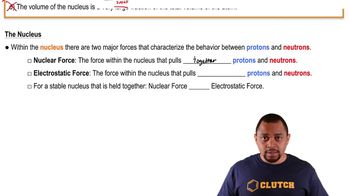
Protons and neutrons are located in the nucleus at the center of the atom.
Electrons orbit the nucleus in regions called electron clouds or shells.
A proton has a positive charge of +1.
A neutron has no charge; it is neutral.
An electron has a negative charge of -1.
The atomic number is the number of protons in an atom's nucleus.
The atomic number determines the element identity.
The mass number is the total number of protons and neutrons in the nucleus.
Isotopes are atoms of the same element with different numbers of neutrons.
Both protons and neutrons have a mass close to 1 atomic mass unit (amu).
An electron's mass is about 1/1836 of a proton's mass, so it is very small.
Number of neutrons = \(\text{mass number} - \text{atomic number}\)
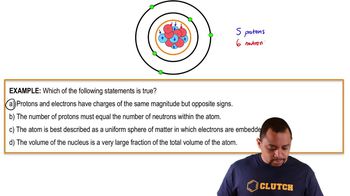
A neutral atom has equal numbers of protons and electrons, so the overall charge is zero.
An ion is an atom or molecule with a net electric charge due to loss or gain of electrons.
A cation is a positively charged ion formed by losing electrons.
An anion is a negatively charged ion formed by gaining electrons.
Electrons, especially in the outer shell, determine an atom's chemical reactivity and bonding.
The nucleus is the dense central core containing protons and neutrons.