Skip to main content
General Chemistry
My Course
Learn
Exam Prep
AI Tutor
Study Guides
Textbook Solutions
Flashcards
Explore
Try the app
My Course
Learn
Exam Prep
AI Tutor
Study Guides
Textbook Solutions
Flashcards
Explore
Try the app
Back
General Chemistry: Atomic Structure and Bonding Concepts
1 student found this helpful
You can tap to flip the card.
What defines the atomic number of an atom?
You can tap to flip the card.
👆
What defines the atomic number of an atom?
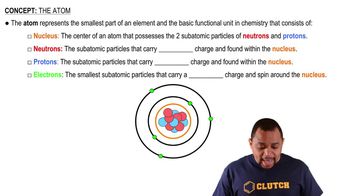
The atomic number
is equal to the number of
protons
in the nucleus.
Track progress
Control buttons has been changed to "navigation" mode.
1/20
Recommended videos
Guided course
02:53
The Nucleus
151
views
1
rank
Guided course
02:10
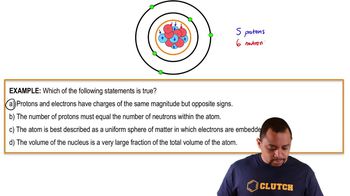
Atom Structure
373
views
14
rank
Guided course
02:52
Atom Structure Example
186
views
7
rank
Terms in this set (20)
Hide definitions
What defines the atomic number of an atom?
The atomic number
is equal to the number of
protons
in the nucleus.
How is the mass number of an atom calculated?
Mass number =
number of protons + number of neutrons
.
What are isotopes?
Atoms with the same atomic number but different
numbers of neutrons
.
What is an atomic orbital?
A region of space around the nucleus where there is a high probability of finding an
electron
.
What is an electron shell and a subshell?
A
shell
is a region of space where electrons orbit; a
subshell
is a region within a shell that can hold a pair of electrons with opposite spins.
What are ions?
Atoms with a different number of electrons than protons;
cations
are positively charged,
anions
are negatively charged.
State the Aufbau Principle.
Electrons fill orbitals in order of increasing energy.
State the Pauli Exclusion Principle.
A maximum of two electrons can occupy an orbital, and they must have opposite spins.
State Hund's Rule.
Electrons fill orbitals of equal energy singly before pairing up.
What does the Heisenberg Uncertainty Principle state?
It is impossible to simultaneously know an electron's exact position and momentum.
What is a wave function in quantum mechanics?
An equation that describes the energy state of an electron and the probability of finding it in a region.
What is an atomic orbital shape?
A 3D plot of the wave function showing where the electron is most likely to be found.
What happens when atomic orbitals overlap constructively?
They form
bonding molecular orbitals
with increased electron density between nuclei.
What is the Linear Combination of Atomic Orbitals (LCAO)?
A method to mathematically combine atomic orbitals to form molecular orbitals by addition or subtraction.
Define sigma (σ) and pi (π) bonds.
σ-bonds
form by head-on overlap of orbitals;
π-bonds
form by side-on overlap of p orbitals.
What is the octet rule?
Atoms tend to gain, lose, or share electrons to achieve a noble gas electron configuration with 8 valence electrons.
How many octet electrons do first-row elements like H, He, and Li prefer?
They prefer to possess
2
octet electrons.
What are formal charges and how are they calculated?
Formal charge = Group number - (number of valence electrons + 1/2 bonding electrons).
What is the skeletal (bondline) structure convention?
Carbons are implied at line ends and bends; hydrogens on carbons are implied; heteroatoms and hydrogens on them are shown explicitly.
What determines the stability of different octet electron arrangements?
The number of
owned electrons
by an atom (lone pairs + one electron per bond) determines the most stable octet.
 BackBack
 02:53
02:53