 Back
BackClassification of Matter - General Chemistry
 01:34
01:34

Terms in this set (19)
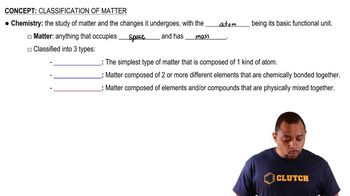
Matter is anything that has mass and occupies space.
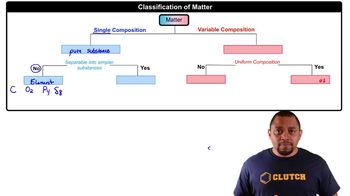
Pure substances and mixtures.
A pure substance has a fixed composition and distinct properties.
Elements are pure substances that cannot be broken down into simpler substances by chemical means.
Compounds are pure substances made of two or more elements chemically combined in fixed ratios.
A mixture contains two or more substances physically combined, with variable composition.
A homogeneous mixture has uniform composition and appearance throughout.
A heterogeneous mixture has visibly different parts or phases.
Examples include oxygen (O), hydrogen (H), and gold (Au).
Examples include water (H\(2\)O) and carbon dioxide (CO\(2\)).
Examples include saltwater and air.
Examples include salad and sand in water.
Mixtures can be separated by physical methods like filtration, distillation, and evaporation.
Compounds have fixed chemical composition and properties, mixtures do not.
The atom is the smallest unit of an element.
The molecule is the smallest unit of a compound.
A physical change alters the form but not the chemical identity of a substance.
A chemical change produces one or more new substances with different properties.
Boiling water is a physical change because the chemical identity of water remains the same.