What is the difference between a scientific theory and a scientific law?
A scientific theory is a broad, testable explanation supported by evidence, while a scientific law describes a universally accepted, testable phenomenon observed in nature.
What are subjects of scientific laws?
Subjects of scientific laws include universally observed phenomena, such as gravity or the conservation of mass.
How many steps are included in the scientific method?
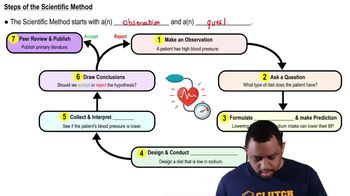
The scientific method typically includes seven steps.
What is a critical part of a scientific conclusion?
A critical part of a scientific conclusion is determining whether the data supports or refutes the hypothesis.
What is an observation of the natural world?
An observation of the natural world is a statement based on sensory or instrumental data, such as 'the patient looks flushed.'
Which aspect of the scientific method occurs first?
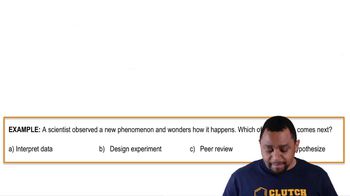
The first aspect is making an observation.
What is the last step in the scientific method?
The last step is peer review and publication of results.
Can you identify the steps in the scientific method that correspond to Hunt's experiments?
The steps include making observations, forming a hypothesis, making predictions, conducting experiments, collecting data, interpreting results, and drawing conclusions.
How should you test a hypothesis?
You should test a hypothesis by designing and conducting a controlled experiment.
Who created the scientific method: Francis Bacon, René Descartes, Robert Boyle, or Johannes Kepler?
Francis Bacon is often credited with formalizing the scientific method.
Creating a testable hypothesis falls between which two steps of the scientific method?
It falls between asking a question and making a prediction.
Which of these are among the steps in the scientific method?
Steps include observation, hypothesis, prediction, experiment, data collection, interpretation, and conclusion.
Which method is the typical first step when scientists communicate their scientific results?
The typical first step is peer review and publication.
Which topic do all scientific questions have in common?
All scientific questions are based on observations of the natural world.
What is the first stage of both technological design and scientific investigation?
The first stage is making an observation.
At which point is a scientific investigator most likely to use deductive reasoning?
Deductive reasoning is most likely used when making predictions based on a hypothesis.
Which activity most likely involves a chemist?
Designing and conducting experiments to study chemical reactions.
What is the purpose of a chemistry final exam review?
The purpose is to help students recall and understand key concepts and prepare for the final exam.
What are the main steps involved in the process of scientific inquiry?
Scientific inquiry involves making observations, forming hypotheses, conducting experiments, and drawing conclusions.
Scientific hypotheses are ________ and falsifiable.
Scientific hypotheses are testable and falsifiable.
What are the 7 steps of the scientific method?
The 7 steps are: observation, question, hypothesis, prediction, experiment, data collection and interpretation, and conclusion.
What is the purpose of a chemistry final review?
The purpose is to reinforce understanding of key chemistry concepts and prepare for assessments.
What is the purpose of a chemistry study guide?
A chemistry study guide helps organize and summarize important concepts for effective studying.
What is the purpose of a chemistry review?
A chemistry review helps students revisit and reinforce key topics before exams.
Classify each description as a hypothesis, theory, or law.
A hypothesis is a testable explanation, a theory is a well-supported explanation, and a law is a universally observed phenomenon.
List possible limitations to scientific models.
Limitations include simplification of reality, assumptions, and inability to account for all variables.
What is the purpose of an ACS practice exam in general chemistry?
It helps students assess their understanding and readiness for the actual ACS general chemistry exam.
The scientific process is ________, involving both inductive and deductive reasoning.
The scientific process is iterative, involving both inductive and deductive reasoning.
What is the main purpose of conducting experiments?
The main purpose is to test hypotheses and gather data to support or refute them.
What is the correct order of steps in the scientific method?
The correct order is: observation, question, hypothesis, prediction, experiment, data collection and interpretation, and conclusion.
The scientific process is involving both
The scientific process involves both inductive and deductive reasoning.
In the context of the scientific method, what is a negative control in an experiment and what is its purpose?
A negative control is a solution or group in an experiment that is not exposed to the experimental treatment or variable being tested. Its purpose is to show what happens in the absence of the experimental factor, helping to ensure that any observed effects are due to the treatment itself and not other variables.
 Back
Back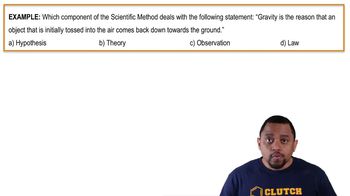
 00:46
00:46