Back

The Ideal Gas Law quiz

Control buttons has been changed to "navigation" mode.
1/15
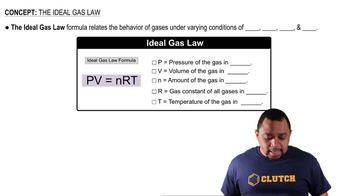
  • What is the formula for the ideal gas law?

    The formula is PV = nRT.
  • What does the variable P represent in the ideal gas law?

    P represents pressure, which is measured in atmospheres (atm).
  • In the ideal gas law, what unit should volume (V) be in?

    Volume should be in liters (L).
  • What does the variable n stand for in the ideal gas law equation?

    n stands for the amount of gas in moles.
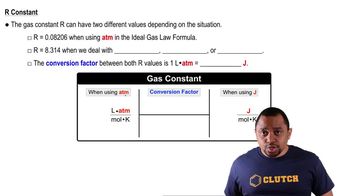
  • What is the value of the gas constant R when using the ideal gas law with pressure in atm and volume in liters?

    R is 0.08206 L·atm/(mol·K).
  • What unit must temperature (T) be in when using the ideal gas law?

    Temperature must be in Kelvin (K).
  • When should you use R = 8.314 J/(mol·K) instead of 0.08206 L·atm/(mol·K)?

    Use R = 8.314 J/(mol·K) when dealing with speed, velocity, or energy calculations.
  • What is the conversion factor between liters·atmospheres and joules?

    1 L·atm equals 101.325 joules.
  • Why is it important to use the correct value of R in calculations?

    Using the correct R value ensures that units are consistent and calculations are accurate.
  • What happens if you use the wrong units for pressure, volume, or temperature in the ideal gas law?

    Using the wrong units will lead to incorrect answers because the gas constant R is unit-specific.
  • How do you convert from L·atm to joules using the conversion factor?

    Multiply the value in L·atm by 101.325 to get the value in joules.
  • What is the significance of the ideal gas law in chemistry?

    It allows us to relate and calculate the properties of gases under various conditions.
  • If a problem involves calculating the energy of a gas, which value of R should you use?

    You should use R = 8.314 J/(mol·K).
  • What does the ideal gas law assume about the behavior of gases?

    It assumes gases behave ideally, meaning they follow the law under most conditions.
  • Why do textbooks often round the value of R to 8.314 J/(mol·K) instead of using the full decimal expansion?

    Textbooks round R to 8.314 for simplicity and ease of calculation.