Back

The Ideal Gas Law: Molar Mass quiz

Control buttons has been changed to "navigation" mode.
1/15
  • What is the definition of molar mass?

    Molar mass is the mass of a substance in grams divided by the amount of substance in moles.
  • What symbol is used to represent molar mass in equations?

    The symbol 'M' (capital M) is used to represent molar mass.
  • How is the mass of a gas represented in the ideal gas law for molar mass calculations?

    The mass of a gas is represented by lowercase 'm' in grams.
  • What is the formula for molar mass using the ideal gas law?

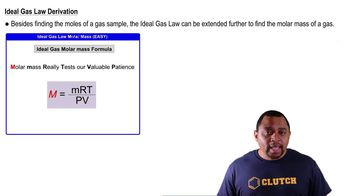
    The formula is M = mRT / PV, where m is mass, R is the gas constant, T is temperature, P is pressure, and V is volume.
  • What does 'n' represent in the ideal gas law?

    'n' represents the amount of gas in moles.
  • How can you express moles in terms of mass and molar mass?

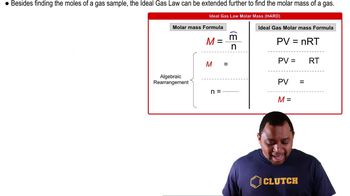
    Moles (n) can be expressed as mass (m) divided by molar mass (M), or n = m / M.
  • How do you derive the molar mass formula from the ideal gas law?

    Substitute n = m / M into PV = nRT, rearrange to isolate M, resulting in M = mRT / PV.
  • What mnemonic can help you remember the molar mass formula?

    The phrase 'molar mass really tests our valuable patience' helps recall M = mRT / PV.
  • What is the value of the ideal gas constant (R) in the molar mass formula?

    R is typically 0.0821 L·atm/(mol·K) when using pressure in atm and volume in liters.
  • Why is the molar mass formula useful for chemists?

    It allows direct calculation of molar mass from experimental gas data, streamlining the process.
  • What units should temperature be in when using the ideal gas law for molar mass?

    Temperature should be in Kelvin.
  • What units should pressure and volume be in for the molar mass calculation?

    Pressure should be in atmospheres and volume in liters, to match the units of R.
  • What is the relationship between molar mass and molecular composition?

    Molar mass provides insight into the molecular composition and behavior of gases.
  • What is the advantage of using the molar mass formula derived from the ideal gas law?

    It eliminates the need for step-by-step calculations and allows immediate determination of molar mass.
  • What should you do if your professor requires you to show the derivation of the molar mass formula?

    You should algebraically rearrange the ideal gas law and substitute n = m / M to derive M = mRT / PV.