Back

The Ideal Gas Law: Density quiz

Control buttons has been changed to "navigation" mode.
1/15
  • What is the formula for density in general chemistry?

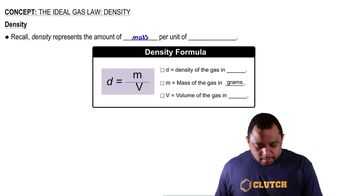
    Density is mass divided by volume, or D = m/v.
  • How is the density of gases typically expressed?

    The density of gases is usually given in grams per liter (g/L).
  • Why don't we use grams per milliliter for gas density?

    Gases are much less dense than solids and liquids, so grams per liter is more appropriate for their density.
  • What is the ideal gas law equation?

    The ideal gas law is PV = nRT.
  • How can the ideal gas law be adapted to calculate gas density?

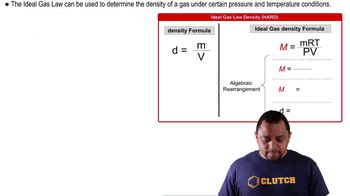
    By manipulating the ideal gas law, we derive D = (P × MM) / (R × T), where MM is molar mass.
  • What does the mnemonic 'Dreams push me over rough times' help you remember?

    It helps you recall the density formula for gases: D = (P × MM) / (R × T).
  • What does 'D' represent in the formula D = (P × MM) / (R × T)?

    D stands for density of the gas.
  • What does 'P' represent in the density formula for gases?

    P represents the pressure of the gas.
  • What does 'MM' represent in the gas density formula?

    MM stands for the molar mass of the gas.
  • What does 'R' represent in the formula D = (P × MM) / (R × T)?

    R is the ideal gas constant.
  • What does 'T' represent in the gas density formula?

    T is the temperature in Kelvin.
  • How do you derive the density formula from the ideal gas law?

    Start with D = m/v and manipulate PV = nRT to isolate density, resulting in D = (P × MM) / (R × T).
  • Why is the density formula for gases important?

    It allows us to predict how gases respond to changes in pressure and temperature.
  • What units should mass and volume be in when calculating gas density?

    Mass should be in grams and volume in liters.
  • What is the relationship between molar mass and density in the context of the ideal gas law?

    Density increases with molar mass when pressure and temperature are constant.