Back

The Ideal Gas Law Applications quiz

Control buttons has been changed to "navigation" mode.
1/15
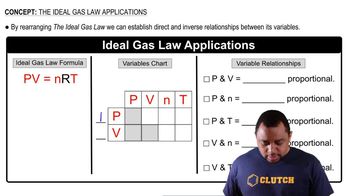
  • What is the equation for the ideal gas law?

    The equation is PV = nRT, where P is pressure, V is volume, n is moles, R is the gas constant, and T is temperature.
  • How are pressure and volume related in the ideal gas law?

    Pressure and volume are inversely proportional; as one increases, the other decreases.
  • What happens to pressure if volume increases, assuming other variables are constant?

    If volume increases, pressure decreases because they are inversely proportional.
  • How are pressure and moles related in the ideal gas law?

    Pressure and moles are directly proportional; increasing one increases the other.
  • What is the relationship between pressure and temperature in the ideal gas law?

    Pressure and temperature are directly proportional; as temperature increases, pressure also increases.
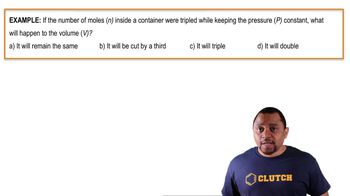
  • How are volume and moles related according to the ideal gas law?

    Volume and moles are directly proportional; increasing moles increases volume.
  • What is the relationship between volume and temperature in the ideal gas law?

    Volume and temperature are directly proportional; as temperature increases, volume increases.
  • Which variable in the ideal gas law is considered a constant?

    R, the gas constant, is considered a constant in the ideal gas law.
  • If pressure increases while other variables are constant, what happens to volume?

    Volume decreases because pressure and volume are inversely proportional.
  • If the number of moles increases and other variables are constant, what happens to pressure?

    Pressure increases since it is directly proportional to the number of moles.
  • If temperature decreases and other variables are constant, what happens to volume?

    Volume decreases because volume and temperature are directly proportional.
  • When comparing pairs of variables in the ideal gas law, which pair is inversely proportional?

    Pressure and volume are the only pair that are inversely proportional.
  • If you increase the temperature of a gas at constant pressure, what happens to the volume?

    The volume increases because volume and temperature are directly proportional.
  • Why do pressure and volume have an inverse relationship in the ideal gas law?

    Because they are on opposite sides of the equation when isolated, so increasing one decreases the other.
  • What should you do when analyzing the relationship between two variables in the ideal gas law?

    Ignore the other variables and focus only on the two variables in question to determine if they are directly or inversely proportional.