Back

The Electron Configuration Review quiz

Control buttons has been changed to "navigation" mode.
1/15
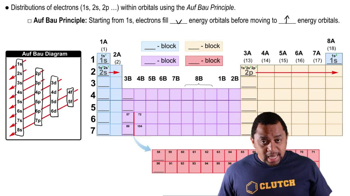
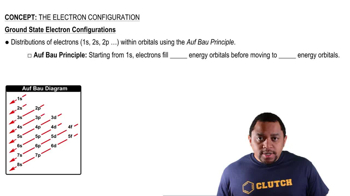
  • What principle dictates the order in which electrons fill atomic orbitals?

    The Aufbau principle dictates that electrons fill lower energy orbitals before higher energy ones.
  • What is the sequence of orbital filling according to the Aufbau principle up to 3d?

    The sequence is 1s, 2s, 2p, 3s, 3p, 4s, then 3d.
  • How many electrons can the s sublevel hold, and how many orbitals does it have?

    The s sublevel has 1 orbital and can hold a maximum of 2 electrons.
  • How many electrons can the p sublevel hold, and how many orbitals does it have?

    The p sublevel has 3 orbitals and can hold a maximum of 6 electrons.
  • How many electrons can the d sublevel hold, and how many orbitals does it have?

    The d sublevel has 5 orbitals and can hold a maximum of 10 electrons.
  • How many electrons can the f sublevel hold, and how many orbitals does it have?

    The f sublevel has 7 orbitals and can hold a maximum of 14 electrons.
  • What does the s block on the periodic table represent?

    The s block represents elements whose outermost electrons occupy s orbitals, and it consists of two columns.
  • How does the periodic table help determine electron configurations?

    The periodic table is divided into s, p, d, and f blocks, which correspond to the sublevels being filled by electrons.
  • What is the electron configuration for hydrogen?

    Hydrogen has the electron configuration 1s¹.
  • What is the electron configuration for helium?

    Helium has the electron configuration 1s².
  • When moving from the s block to the d block, how does the principal quantum number change?

    The principal quantum number for the d block is one less than that of the preceding s block (e.g., after 4s comes 3d).
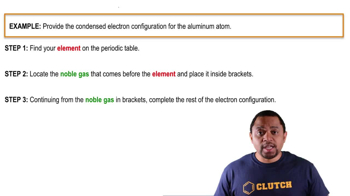
  • What is a condensed electron configuration?

    A condensed electron configuration uses the symbol of the last noble gas before the element as a reference point, followed by the remaining configuration.
  • When should you use the condensed electron configuration method?

    You should use the condensed electron configuration unless specifically asked for the full ground state configuration.
  • Where are the f block elements located on the periodic table, and how are they numbered?

    The f block elements are located below the main body of the periodic table and are numbered as 4f and 5f, corresponding to periods 6 and 7.
  • Why is understanding electron configuration important in chemistry?

    Understanding electron configuration is crucial for predicting the chemical properties and behaviors of elements.