Skip to main content
General Chemistry
My Course
Learn
Exam Prep
AI Tutor
Study Guides
Textbook Solutions
Flashcards
Explore
Try the app
My Course
Learn
Exam Prep
AI Tutor
Study Guides
Textbook Solutions
Flashcards
Explore
Try the app
Back
Test for Ions and Gases quiz
You can tap to flip the card.
What reagents are added to a solution to test for chloride, bromide, and iodide ions?
You can tap to flip the card.
👆
What reagents are added to a solution to test for chloride, bromide, and iodide ions?
Nitric acid is added first, followed by silver nitrate.
Track progress
Control buttons has been changed to "navigation" mode.
1/15
Related flashcards
Related practice
Recommended videos
Test for Ions and Gases definitions
Test for Ions and Gases
15 Terms
Test for Ions and Gases quiz #1
Test for Ions and Gases
11 Terms
Test for Ions and Gases
4. BONUS: Lab Techniques and Procedures
10 problems
Topic
Extraction
4. BONUS: Lab Techniques and Procedures
10 problems
Topic
4. BONUS: Lab Techniques and Procedures
7 topics
15 problems
Chapter
Guided course
14:42
Test for Anions
16
views
Terms in this set (15)
Hide definitions
What reagents are added to a solution to test for chloride, bromide, and iodide ions?
Nitric acid is added first, followed by silver nitrate.
What color precipitate indicates the presence of chloride ions when tested with silver nitrate?
A white precipitate forms, indicating chloride ions.
How can you distinguish between bromide and iodide ions using the silver nitrate test?
Bromide forms a creamy white precipitate, while iodide forms a yellow precipitate.
What gas is produced when carbonate or bicarbonate ions react with hydrochloric acid?
Carbon dioxide gas (CO2) is produced.
How can you differentiate between carbonate and bicarbonate ions after adding hydrochloric acid?
Add magnesium sulfate; a white precipitate forms with carbonate but not with bicarbonate.
What is the visual indication of carbon dioxide gas being produced in a solution?
The solution becomes cloudy white due to CO2 gas bubbles.
Which ions form a white precipitate when barium chloride is added after hydrochloric acid?
Both sulfate and bisulfate ions form a white precipitate.
How can you distinguish between sulfate and bisulfate ions after forming a barium sulfate precipitate?
Heat the solid; SO3 gas forms with light heating for bisulfate, but only with strong heating for sulfate.
What does the evolution of a lot of CO2 gas upon adding sodium carbonate indicate about the ion present?
It indicates the presence of bisulfate ion.
What gas is released when sulfite ions react with hydrochloric acid, and how can you detect it?
Sulfur dioxide (SO2) gas is released, which has a strong, unpleasant odor.
What is the brown ring test used to identify?
It is used to identify the presence of nitrate ions.
What reagents are used in the brown ring test for nitrate ions?
Cold iron(II) sulfate is added, followed by sulfuric acid.
What is a precipitate in the context of ion testing?
A precipitate is a solid that forms in solution during a chemical reaction.
Why is fluoride ion not typically tested with silver nitrate in these experiments?
Fluoride ion is not tested due to its dangerous properties in these reactions.
What does the absence of a precipitate after adding nitric acid and silver nitrate indicate?
It indicates that chloride, bromide, or iodide ions are not present in the solution.
 BackBack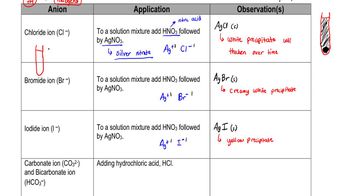
 14:42
14:42