Back

Significant Figures: In Calculations quiz

Control buttons has been changed to "navigation" mode.
1/15
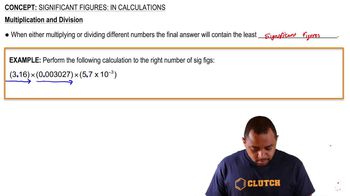
  • When multiplying or dividing numbers in chemistry, how do you determine the number of significant figures in the final answer?

    The final answer should have the same number of significant figures as the measurement with the fewest significant figures.
  • How do you count significant figures in a number with a decimal point?

    Start counting from the first nonzero digit on the left and count all digits to the end.
  • In the calculation 3.16 × 0.003027 × 5.7 × 10⁻³, which value determines the number of significant figures in the final answer?

    The value with the least number of significant figures, which is 5.7 × 10⁻³ with 2 significant figures.
  • What should you do if the digit to the right of your last significant figure is 5 or greater when rounding?

    You should round up the last significant figure by one.
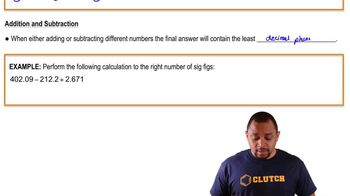
  • When adding or subtracting numbers, what determines the number of decimal places in the final answer?

    The final answer should have the same number of decimal places as the measurement with the least decimal places.
  • If you add 402.09, subtract 12.2, and add 2.671, how many decimal places should your answer have?

    The answer should have one decimal place, matching the least precise measurement (12.2).
  • How does the number of decimal places in addition/subtraction affect the number of significant figures in the answer?

    The number of decimal places directly impacts the number of significant figures in the final answer.
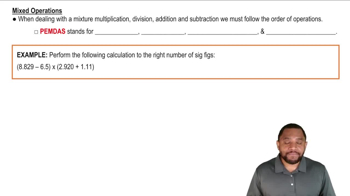
  • What is the order of operations you should follow in mixed calculations involving significant figures?

    Follow parentheses, exponents, multiplication/division, then addition/subtraction (PEMDAS).
  • In a mixed operation, when do you apply the significant figure rules for multiplication/division versus addition/subtraction?

    Apply the multiplication/division rule for significant figures and the addition/subtraction rule for decimal places at each respective step.
  • If you multiply 1.89 × 10⁶ by 3.005, how many significant figures should the result have?

    The result should have 3 significant figures, matching the value with the fewest significant figures.
  • When raising 5.21 to the third power, how many significant figures should the answer have?

    The answer should have 3 significant figures, since 5.21 has 3 significant figures.
  • If you subtract 8.829 and 6.5, how many decimal places should the result have?

    The result should have 1 decimal place, matching the least precise measurement (6.5).
  • When adding 2.920 to a number with 1 decimal place, how many decimal places should the sum have?

    The sum should have 1 decimal place, matching the least precise measurement.
  • If your final step is dividing 8.01 × 10⁸ by 5.2, how many significant figures should your answer have?

    The answer should have 2 significant figures, matching the value with the fewest significant figures (5.2).
  • What is the general rule for significant figures in multiplication/division versus addition/subtraction?

    Use the least number of significant figures for multiplication/division and the least number of decimal places for addition/subtraction.