Back

Rate of Radioactive Decay quiz

Control buttons has been changed to "navigation" mode.
1/15
  • What order of rate law do all radioactive decay processes follow?

    All radioactive decay processes follow a first-order rate law.
  • What is the integrated rate law equation for radioactive decay?

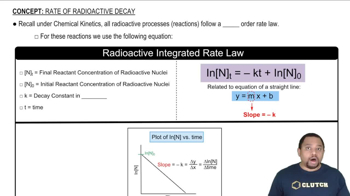
    The integrated rate law is ln(N) = -kt + ln(N0), where N is the final amount, N0 is the initial amount, k is the decay constant, and t is time.
  • In the radioactive decay equation, what does N represent?

    N represents the final amount of radioactive nuclei remaining after time t.
  • What does N0 (N naught) stand for in the integrated rate law?

    N0 is the initial amount of radioactive nuclei present at time zero.
  • What is the meaning of the decay constant k in the context of radioactive decay?

    The decay constant k represents the probability per unit time that a nucleus will decay; its units are inverse time.
  • How must the units of time and the decay constant k relate to each other?

    The units of time must match the inverse units of the decay constant k (e.g., if k is in days⁻¹, time must be in days).
  • What does the negative sign in the equation ln(N) = -kt + ln(N0) indicate?

    The negative sign indicates that the amount of radioactive nuclei decreases over time.
  • How is the radioactive decay equation similar to the equation of a straight line?

    It is similar because ln(N) = -kt + ln(N0) matches the form y = mx + b, with y as ln(N), m as -k, x as t, and b as ln(N0).
  • What is plotted on the y-axis and x-axis when graphing radioactive decay using the integrated rate law?

    The y-axis is ln(N) (natural log of the final concentration), and the x-axis is time.
  • What does the slope of the line represent in a plot of ln(N) versus time?

    The slope of the line is equal to -k, the negative decay constant.
  • What does the intercept (b) represent in the straight-line form of the radioactive decay equation?

    The intercept b is ln(N0), the natural log of the initial amount of radioactive nuclei.
  • Besides molarity, what other units can be used for N and N0 in radioactive decay?

    N and N0 can be expressed in units such as disintegrations per second, not just molarity.
  • How do you calculate the change in the natural log of concentration over time on a graph?

    It is calculated as the change in ln(N) divided by the change in time (Δy/Δx).
  • Why is it important to remember the radioactive integrated rate law equation?

    Because it is the primary equation used to analyze and solve problems involving radioactive decay.
  • What is the general trend of the graph of ln(N) versus time for radioactive decay?

    The graph shows a straight line with a negative slope, indicating a continuous decrease in radioactive nuclei over time.