Back

Precipitation: Ksp vs Q quiz

Control buttons has been changed to "navigation" mode.
1/15
  • What does Ksp represent in a precipitation reaction?

    Ksp is the solubility product constant, indicating the maximum concentration of ions that can dissolve in a solvent at equilibrium.
  • What does the reaction quotient Q represent?

    Q is the ratio of products to reactants at a particular moment, not necessarily at equilibrium.
  • What happens when Q is less than Ksp?

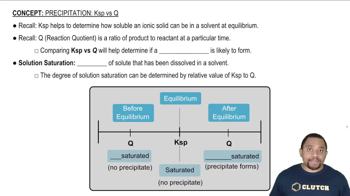
    The solution is unsaturated, and no precipitate forms as the reaction shifts forward to dissolve more solute.
  • What does it mean if Q equals Ksp?

    The solution is saturated and at equilibrium, so no precipitate forms and no net change occurs.
  • What occurs when Q is greater than Ksp?

    The solution is supersaturated, and a precipitate forms as the reaction shifts in reverse to reach equilibrium.
  • How does the chemical reaction shift when Q < Ksp?

    The reaction shifts forward, producing more ions to reach equilibrium.
  • How does the chemical reaction shift when Q > Ksp?

    The reaction shifts in the reverse direction, forming more solid (precipitate) to reach equilibrium.
  • What is solution saturation?

    Solution saturation is the amount of solute dissolved in a solvent relative to the maximum possible at equilibrium.
  • What type of solution is present when Q < Ksp?

    An unsaturated solution is present, meaning more solute can dissolve.
  • What type of solution is present when Q = Ksp?

    A saturated solution is present, with the maximum amount of solute dissolved.
  • What type of solution is present when Q > Ksp?

    A supersaturated solution is present, containing more dissolved solute than is stable at equilibrium.
  • Why does a precipitate form when Q > Ksp?

    A precipitate forms because the solution contains more ions than can remain dissolved, so excess ions combine to form a solid.
  • Does a precipitate form when Q = Ksp?

    No, because the solution is at equilibrium and no net change occurs.
  • Does a precipitate form when Q < Ksp?

    No, because the solution is unsaturated and can dissolve more solute.
  • How can comparing Q and Ksp help predict precipitation?

    By comparing Q and Ksp, you can determine if a precipitate will form: if Q > Ksp, precipitation occurs; if Q ≤ Ksp, it does not.