Back

Periodic Trend: Successive Ionization Energies quiz

Control buttons has been changed to "navigation" mode.
1/15
  • What is the first ionization energy (IE1) of an atom?

    It is the energy required to remove the first electron from a gaseous atom, resulting in a positively charged ion.
  • How does the charge of an atom change after each electron is removed in successive ionizations?

    The atom becomes more positively charged with each electron removed, increasing its charge by +1 each time.
  • Why do successive ionization energies increase for an element?

    Each subsequent electron is harder to remove because the ion becomes more positively charged, increasing the attraction to the remaining electrons.
  • What happens to the ionization energy when inner core electrons are removed after all valence electrons are gone?

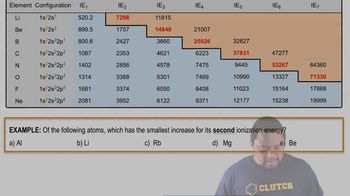
    There is a large jump in ionization energy, indicating much more energy is needed to remove inner core electrons.
  • How can large jumps in ionization energy help predict the number of valence electrons in an element?

    The jump occurs after all valence electrons are removed, revealing how many electrons an element tends to lose to achieve a noble gas configuration.
  • What is the trend in ionization energy values as more electrons are removed from an atom?

    Ionization energy values increase with each successive electron removed.
  • Why does lithium show a large increase in ionization energy after the first electron is removed?

    After losing its single valence electron, removing a core electron requires much more energy, resulting in a large jump.
  • What is the relationship between group number and the number of electrons an element tends to lose?

    Elements tend to lose a number of electrons equal to their group number to achieve a noble gas configuration.
  • What is meant by 'successive ionization energies'?

    It refers to the energies required to remove electrons one at a time from an atom, each removal occurring in stages.
  • Why can't all electrons be removed from an atom at once during ionization?

    Electrons must be removed one at a time, with each stage requiring its own specific ionization energy.
  • What happens to the ionization energy when removing the third electron from beryllium?

    There is a significant jump in ionization energy, indicating the removal of a core electron after the two valence electrons are gone.
  • How does the desire to achieve a noble gas configuration affect ionization energies?

    Elements lose electrons to become isoelectronic with noble gases, and ionization energies increase sharply after this configuration is reached.
  • What is the significance of a 'spike' in ionization energy for an element?

    A spike indicates that all valence electrons have been removed and the next electron is a core electron, requiring much more energy.
  • How does oxygen's ionization energy change after losing six electrons?

    After losing six electrons, oxygen reaches a noble gas configuration, and removing the seventh electron causes a huge increase in ionization energy.
  • What does the term 'isoelectronic' mean in the context of ionization energies?

    Isoelectronic means having the same electron configuration as a noble gas, which elements achieve by losing their valence electrons.