Back

Periodic Trend: Ionization Energy quiz

Control buttons has been changed to "navigation" mode.
1/15
  • What is ionization energy?

    Ionization energy is the energy required to remove an electron from a gaseous atom or ion, resulting in a positive charge.
  • Is ionization energy an endothermic or exothermic process?

    Ionization energy is an endothermic process because energy is absorbed to remove the electron.
  • What happens to the charge of an atom when an electron is removed?

    The atom becomes positively charged after an electron is removed.
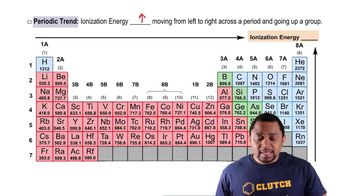
  • How does ionization energy change across a period in the periodic table?

    Ionization energy increases as you move from left to right across a period.
  • How does ionization energy change as you move up a group in the periodic table?

    Ionization energy increases as you move up a group in the periodic table.
  • Which element has the highest ionization energy?

    Helium has the highest ionization energy in the periodic table.
  • Which element has the lowest ionization energy?

    Francium has the lowest ionization energy in the periodic table.
  • Why is nitrogen’s ionization energy higher than oxygen’s?

    Nitrogen has a higher ionization energy because its half-filled p orbitals are more stable, making it less willing to lose an electron.
  • Why does oxygen have a lower ionization energy than nitrogen?

    Oxygen is more willing to lose an electron to achieve a half-filled p orbital, which is more stable, so less energy is required.
  • Why does beryllium have a higher ionization energy than boron?

    Beryllium’s fully filled s orbitals are very stable, so more energy is needed to remove an electron compared to boron.
  • What is the stability condition for p orbitals related to ionization energy exceptions?

    P orbitals are most stable when they are half-filled or fully filled, affecting ionization energy values.
  • What is the stability condition for s orbitals related to ionization energy exceptions?

    S orbitals are most stable when they are fully filled, which can lead to higher ionization energies.
  • What is the general trend for ionization energy on the periodic table?

    Ionization energy generally increases toward the top right corner of the periodic table.
  • What happens to the potential energy of an electron during ionization?

    The potential energy of the electron increases as energy is absorbed to remove it from the atom.
  • Why do group 3A elements have lower ionization energy than group 2A elements in the same period?

    Group 2A elements have fully filled s orbitals, making them more stable and harder to remove an electron compared to group 3A elements.