Back

Periodic Trend: Atomic Radius quiz

Control buttons has been changed to "navigation" mode.
1/15
  • What is atomic radius?

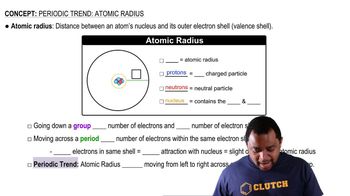
    Atomic radius is the distance from an atom's nucleus to its outer (valence) electron shell.
  • What happens to atomic radius as you move down a group in the periodic table?

    Atomic radius increases as you move down a group because more electron shells are added.
  • Why does atomic radius increase down a group?

    It increases because each successive element has an additional electron shell, making the atom larger.
  • What is the trend in atomic radius as you move from left to right across a period?

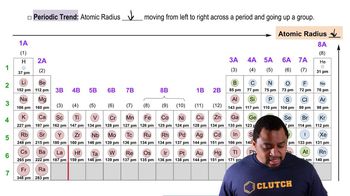
    Atomic radius decreases as you move from left to right across a period.
  • Why does atomic radius decrease across a period?

    It decreases because the number of electrons in the same shell increases, strengthening the attraction to the nucleus and pulling electrons closer.
  • What is found in the nucleus of an atom?

    The nucleus contains protons, which are positively charged, and neutrons, which are neutral.
  • How does the number of electron shells affect atomic radius?

    More electron shells mean a larger atomic radius because the outer electrons are farther from the nucleus.
  • What happens to the number of electrons in the same shell as you move across a period?

    The number of electrons in the same shell increases as you move across a period.
  • How does increasing the number of electrons in the same shell affect atomic radius?

    It increases the attraction to the nucleus, causing the atomic radius to decrease.
  • Where on the periodic table are the smallest atomic radii found?

    The smallest atomic radii are found at the top right corner of the periodic table.
  • Are there exceptions to the general trend of atomic radius?

    Yes, exceptions occur, especially with transition metals and lab-synthesized elements.
  • Why are atomic radii for some elements not well-defined?

    Some elements, especially those synthesized in laboratories, are unstable and lack definitive atomic radius data.
  • In what units is atomic radius typically measured?

    Atomic radius is typically measured in picometers (pm).
  • Should you memorize specific atomic radius values for elements?

    No, you should focus on understanding the general trend rather than memorizing specific values.
  • What is the overall trend for atomic radius on the periodic table?

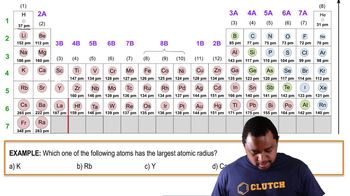
    Atomic radius generally increases down a group and decreases from left to right across a period.