Back

Periodic Table Charges Review quiz

Control buttons has been changed to "navigation" mode.
1/15
  • Why do elements on the periodic table gain or lose electrons?

    Elements gain or lose electrons to achieve the same number of outer shell electrons as the nearest noble gas, resulting in a stable configuration.
  • What type of ions do metals typically form, and why?

    Metals typically form positively charged ions called cations because they lose electrons.
  • What is the difference between type 1 and type 2 metals?

    Type 1 metals have only one possible positive charge, while type 2 metals can have multiple positive charges.
  • What type of ions do nonmetals form, and how?

    Nonmetals form negatively charged ions called anions by gaining electrons.
  • What is the charge of noble gases, and why?

    Noble gases have a charge of 0 because they already have a stable, optimal number of electrons and do not need to gain or lose any.
  • What is the typical charge for elements in group 1A (group 1)?

    Elements in group 1A typically have a charge of +1 because they lose one electron to achieve noble gas configuration.
  • What is the typical charge for elements in group 2A (group 2)?

    Elements in group 2A typically have a charge of +2 because they lose two electrons.
  • What charge do group 3A (group 13) metals like aluminum usually have?

    Group 3A metals like aluminum usually have a charge of +3 because they lose three electrons.
  • What is the usual charge for nonmetals in group 5A (group 15)?

    Nonmetals in group 5A usually have a charge of -3 because they gain three electrons.
  • How many electrons do group 6A (group 16) nonmetals gain, and what charge do they form?

    Group 6A nonmetals gain two electrons and form a -2 charge.
  • What is the typical charge for group 7A (group 17) nonmetals?

    Group 7A nonmetals typically have a charge of -1 because they gain one electron.
  • Why is group 4A (group 14) considered 'not applicable' for typical charges?

    Group 4A is considered 'not applicable' because elements like carbon can either gain or lose four electrons, making their charge less predictable.
  • What are the common charges for tin (Sn) and lead (Pb), and why are they exceptions?

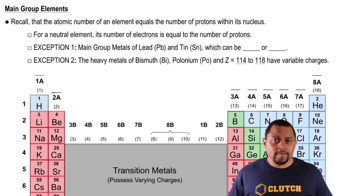
    Tin and lead can have charges of +2 or +4, making them exceptions because they behave similarly to transition metals.
  • What is unique about the charges of transition metals?

    Most transition metals can have multiple positive charges, making them type 2 metals, but some have only one specific charge.
  • Which transition metals have only one common charge, and what are those charges?

    Scandium is always +3, silver is +1, and both cadmium and zinc are +2.