Back

Oxides, Peroxides, and Superoxides quiz

Control buttons has been changed to "navigation" mode.
1/15
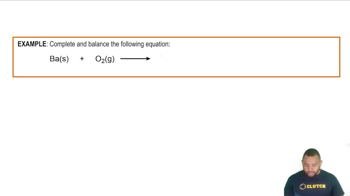
  • What are oxides, peroxides, and superoxides?

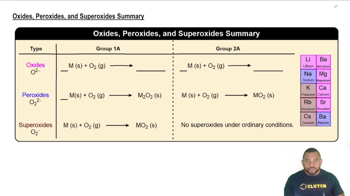
    They are binary compounds of oxygen with metals, specifically from groups 1A and 2A.
  • What is the formula and charge for an oxide ion?

    The oxide ion is O²⁻, with one oxygen atom and a 2- charge.
  • What is the formula and charge for a peroxide ion?

    The peroxide ion is O₂²⁻, with two oxygen atoms and a 2- charge.
  • What is the formula and charge for a superoxide ion?

    The superoxide ion is O₂⁻, with two oxygen atoms and a 1- charge.
  • Which group of metals does not form superoxides under normal conditions?

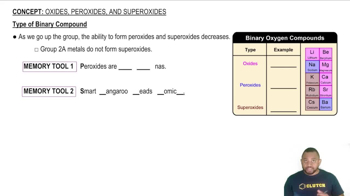
    Group 2A metals do not form superoxides under normal conditions.
  • How does the ability to form peroxides and superoxides change as you move up a group?

    The ability to form peroxides and superoxides decreases as you move up the group.
  • What is the memory tool for remembering which elements form peroxides?

    "Peroxides are bananas" helps recall that barium and sodium form peroxides.
  • What is the memory tool for remembering which elements form superoxides?

    "Smart kangaroos read comics" stands for potassium, rubidium, and cesium, which form superoxides.
  • What is the general formula for an oxide formed with a group 1A metal?

    The formula is M₂O, where M is a group 1A metal.
  • What is the general formula for an oxide formed with a group 2A metal?

    The formula is MO, where M is a group 2A metal.
  • What is the general formula for a peroxide formed with a group 1A metal?

    The formula is M₂O₂, where M is a group 1A metal.
  • What is the general formula for a peroxide formed with a group 2A metal?

    The formula is MO₂, where M is a group 2A metal.
  • What is the general formula for a superoxide formed with a group 1A metal?

    The formula is MO₂, where M is potassium, rubidium, or cesium.
  • Which group 1A element forms only oxides and not peroxides or superoxides?

    Lithium forms only oxides.
  • If an element is not part of the memory tools for peroxides or superoxides, what type of oxygen compound does it form?

    It forms an oxide.