Back

Nitrogen Family Reactions quiz

Control buttons has been changed to "navigation" mode.
1/15
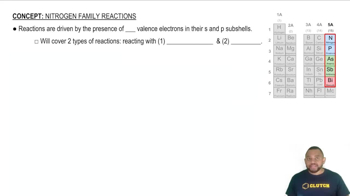
  • What is the common characteristic of all group 5A (nitrogen family) elements?

    They all have five valence electrons in their s and p subshells.
  • Which types of elements are found in the nitrogen family (group 5A)?

    The group includes nonmetals (nitrogen, phosphorus), metalloids (arsenic, antimony), and a metal (bismuth).
  • Why can't nitrogen form pentahalides?

    Nitrogen is in period 2 and cannot have an expanded octet, so it cannot form pentahalides.
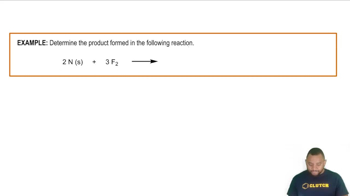
  • What compounds are formed when group 5A elements react with halogens?

    They form trihalides (EX3) and, for some elements, pentahalides (EX5).
  • Which group 5A elements can form pentahalides?

    Nonmetals and metalloids from period 3 and lower, such as phosphorus, arsenic, and antimony, can form pentahalides.
  • What is the general formula for a trihalide formed by a group 5A element?

    The general formula is EX3, where E is the group 5A element and X is the halogen.
  • How many moles of diatomic halogen are needed to convert a group 5A element to a pentahalide?

    A total of 4 moles of diatomic halogen are needed.
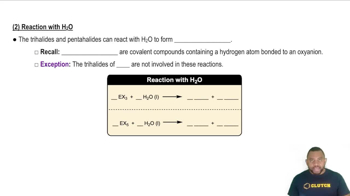
  • What is produced when a trihalide reacts with water?

    A trihalide reacts with water to form an oxyacid with three oxygens and a hydrogen halide byproduct.
  • What is the formula for the oxyacid formed from a trihalide and water?

    The formula is H3EO3, where E is the group 5A element.
  • What is the maximum number of oxygens found in oxyacids formed from pentahalides?

    The maximum number is four oxygens.
  • What is the formula for the oxyacid formed from a pentahalide and water?

    The formula is H3EO4, where E is the group 5A element.
  • What is always produced as a byproduct when trihalides or pentahalides react with water?

    A hydrogen halide is always produced as a byproduct.
  • Why do pentahalides not form oxyacids with five oxygens?

    Oxyacids do not go above four oxygens, so pentahalides form oxyacids with only four oxygens.
  • Which group 5A element's trihalides do NOT react with water to form oxyacids?

    Nitrogen's trihalides do not participate in these reactions.
  • What is the relationship between the number of halogens in a trihalide and the number of oxygens in the resulting oxyacid?

    Trihalides with three halogens produce oxyacids with three oxygens.