Back

Nature of Energy quiz

Control buttons has been changed to "navigation" mode.
1/15
  • What is thermochemistry the study of?

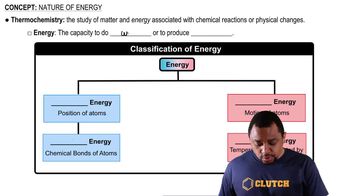
    Thermochemistry is the study of matter and energy associated with chemical reactions or physical changes.
  • How is energy defined in thermochemistry?

    Energy is defined as the capacity to do work or to produce heat.
  • What are the two main categories of energy discussed in this chapter?

    The two main categories are potential energy (energy of position) and kinetic energy (energy of motion).
  • What type of energy is associated with the position of atoms?

    Potential energy is associated with the position of atoms.
  • What type of energy is related to the motion of atoms?

    Kinetic energy is related to the motion of atoms.
  • What is chemical energy and how is it classified?

    Chemical energy is a form of potential energy that arises from chemical bonds between atoms.
  • What is thermal energy and how is it classified?

    Thermal energy is a type of kinetic energy associated with temperature changes due to atomic motion.
  • What is the SI unit for energy?

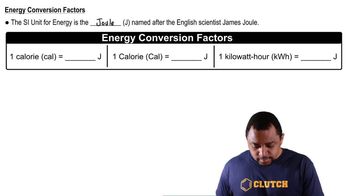
    The SI unit for energy is the joule (J).
  • Who is the joule named after?

    The joule is named after the English scientist James Joule.
  • How many joules are in one calorie (lowercase c)?

    One calorie (c) equals 4.184 joules.
  • How many joules are in one food Calorie (uppercase C)?

    One food Calorie (C) equals 4184 joules.
  • How many joules are in one kilowatt-hour?

    One kilowatt-hour equals 3.6 × 10^6 joules.
  • Are energy conversion factors typically required to be memorized for exams?

    No, energy conversion factors are usually provided in questions or on formula sheets during exams.
  • What is the main focus regarding energy in this chapter?

    The main focus is on potential energy, kinetic energy, chemical energy, and thermal energy.
  • What is the relationship between thermal energy and temperature?

    Thermal energy is linked to temperature changes caused by the motion of atoms.