Back

Naming Other Substituents quiz

Control buttons has been changed to "navigation" mode.
1/15
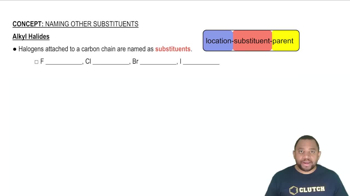
  • What is an alkyl halide?

    An alkyl halide is an alkyl group connected to a halogen atom.
  • How are halogens named when they act as substituents on a carbon chain?

    Halogens are named as fluoro, chloro, bromo, or iodo when they act as substituents.
  • What must be specified when naming a halogen substituent on a parent chain?

    The numerical location of the halogen on the parent chain must be specified.
  • What is the substituent name for fluorine?

    Fluorine as a substituent is called fluoro.
  • What is the substituent name for chlorine?

    Chlorine as a substituent is called chloro.
  • What is the substituent name for bromine?

    Bromine as a substituent is called bromo.
  • What is the substituent name for iodine?

    Iodine as a substituent is called iodo.
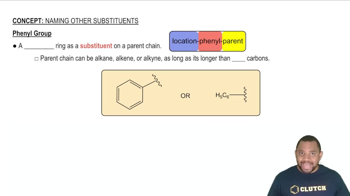
  • What is a phenyl group?

    A phenyl group is a benzene ring (C6H5) acting as a substituent on a parent chain.
  • What is the molecular formula for benzene?

    The molecular formula for benzene is C6H6.
  • How does the formula of benzene change when it becomes a phenyl group?

    One hydrogen is removed from benzene, making it C6H5 as a phenyl group.
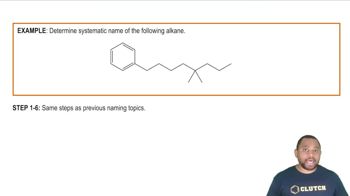
  • How is the phenyl group represented in skeletal formulas?

    The phenyl group is shown as a six-membered ring with alternating double and single bonds.
  • When naming a compound with a phenyl group, what order is used?

    The location of the phenyl group is stated first, followed by the parent chain name.
  • What types of parent chains can a phenyl group attach to?

    A phenyl group can attach to alkane, alkene, or alkyne chains longer than six carbons.
  • Why is it important to understand the nomenclature of these substituents?

    Understanding the nomenclature helps identify the structure and composition of organic compounds.
  • What happens to the hydrogen atom on benzene when it becomes a substituent?

    One hydrogen atom is removed from benzene so it can attach to a larger chain as a substituent.