Back

Law of Conservation of Mass quiz

Control buttons has been changed to "navigation" mode.
1/15
  • Who established the law of conservation of mass?

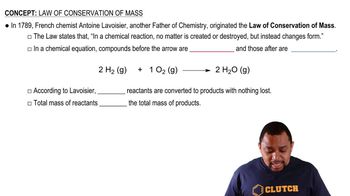
    Antoine Lavoisier established the law of conservation of mass.
  • What does the law of conservation of mass state about matter in a chemical reaction?

    It states that matter is neither created nor destroyed in a chemical reaction, but changes form.
  • In a chemical reaction, what must be equal according to the law of conservation of mass?

    The mass of the reactants must equal the mass of the products.
  • What are reactants in a chemical reaction?

    Reactants are the substances present before the reaction, shown before the arrow in a chemical equation.
  • What are products in a chemical reaction?

    Products are the substances formed as a result of the reaction, shown after the arrow in a chemical equation.
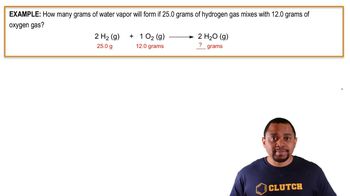
  • If 100 grams of hydrogen and oxygen react, how much water will be produced according to the law of conservation of mass?

    100 grams of water will be produced, as the mass is conserved.
  • How does the law of conservation of mass relate to balanced chemical equations?

    It reinforces the need for balanced equations, ensuring the mass of reactants equals the mass of products.
  • Why is the law of conservation of mass important for stoichiometry?

    It allows us to predict the amount of products formed from given reactants by ensuring mass is conserved.
  • What happens to the mass of reactants during a chemical reaction?

    The mass of reactants is transformed into the mass of products, with nothing lost.
  • How does the law of conservation of mass help in solution chemistry?

    It guides calculations of product amounts from reactant masses, ensuring mass is conserved.
  • What does the law of conservation of mass tell us about the transformation of substances?

    It tells us substances are transformed from one form to another without any loss of mass.
  • What is the significance of knowing the total mass of reactants at the start of a reaction?

    Knowing the total mass of reactants allows us to determine the total mass of products formed.
  • How does the law of conservation of mass connect to other chemistry concepts?

    It connects to stoichiometry and solution chemistry by providing a basis for calculating product amounts.
  • What would happen if the mass of products was less than the mass of reactants in a reaction?

    This would violate the law of conservation of mass, as mass must be conserved in a chemical reaction.
  • Why is the law of conservation of mass considered a foundational concept in chemistry?

    It underpins chemical equations, stoichiometry, and the understanding of chemical processes by ensuring mass is conserved.