Back

Kinetic & Potential Energy quiz

Control buttons has been changed to "navigation" mode.
1/15
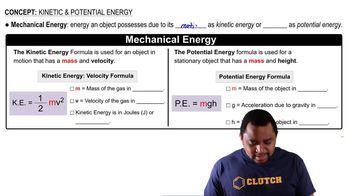
  • What is the formula for calculating kinetic energy?

    Kinetic energy (KE) is calculated as KE = 1/2 m v^2, where m is mass in kilograms and v is velocity in meters per second.
  • What does the 'm' represent in the kinetic energy formula?

    'm' represents the mass of the object, measured in kilograms.
  • In the kinetic energy formula, what does 'v' stand for and what are its units?

    'v' stands for velocity, and its units are meters per second (m/s).
  • What are the units of kinetic energy?

    Kinetic energy is measured in joules (J), which are equivalent to kg·m^2/s^2.
  • What is the formula for potential energy?

    Potential energy (PE) is calculated as PE = mgh, where m is mass, g is acceleration due to gravity, and h is height.
  • What value is typically used for 'g', the acceleration due to gravity, on Earth?

    On Earth, 'g' is typically 9.8 meters per second squared (m/s^2).
  • What does 'h' represent in the potential energy formula?

    'h' represents the height of the object above a reference point, measured in meters.
  • How are kinetic energy and potential energy related to mechanical energy?

    Mechanical energy is the sum of kinetic energy and potential energy in an object.
  • Can kinetic energy be converted into potential energy and vice versa?

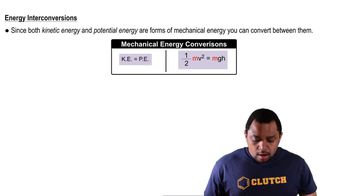
    Yes, kinetic energy and potential energy are interconvertible forms of mechanical energy.
  • What is the abbreviation for kinetic energy and potential energy?

    Kinetic energy is abbreviated as KE, and potential energy is abbreviated as PE.
  • If an object is stationary but elevated, which type of energy does it primarily have?

    A stationary but elevated object primarily has potential energy.
  • If an object is moving, which type of energy does it possess?

    A moving object possesses kinetic energy.
  • What is the equation that shows the conversion between kinetic and potential energy?

    The conversion is shown as 1/2 m v^2 = mgh, where kinetic energy equals potential energy.
  • What are the SI units for mass, velocity, and height in the energy formulas?

    Mass is in kilograms (kg), velocity in meters per second (m/s), and height in meters (m).
  • Why is understanding kinetic and potential energy important in science?

    Understanding these energies and their formulas is crucial for converting between them and forms the foundation for physics and other sciences.