Back

Kinetic Energy of Gases quiz

Control buttons has been changed to "navigation" mode.
1/15
  • What is kinetic energy?

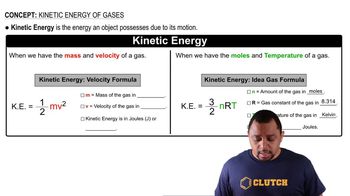
    Kinetic energy is the energy an object possesses due to its motion.
  • What formula is used to calculate kinetic energy when mass and velocity are known?

    KE = 1/2 m v^2, where m is mass in kilograms and v is velocity in meters per second.
  • What are the units for mass and velocity in the kinetic energy formula KE = 1/2 m v^2?

    Mass is in kilograms and velocity is in meters per second.
  • What are the units of kinetic energy when calculated using mass and velocity?

    The units are joules, which are equivalent to kg·m^2/s^2.
  • How is kinetic energy calculated when moles and temperature are known?

    KE = (3/2) nRT, where n is moles, R is the gas constant, and T is temperature in Kelvin.
  • What value is used for the ideal gas constant R in kinetic energy calculations?

    R = 8.314 J/mol·K.
  • What units result from the calculation KE = (3/2) nRT?

    The units are liters·atmospheres, which can be converted to joules.
  • What is the conversion factor from liters·atmospheres to joules?

    1 L·atm = 101.325 joules.
  • When should you use KE = 1/2 m v^2 for kinetic energy calculations?

    Use this formula when you know the mass and velocity of the gas.
  • When should you use KE = (3/2) nRT for kinetic energy calculations?

    Use this formula when you know the moles and temperature of the gas.
  • What does 'n' represent in the formula KE = (3/2) nRT?

    'n' represents the number of moles of the gas.
  • What does 'T' represent in the formula KE = (3/2) nRT?

    'T' represents the temperature in Kelvin.
  • Do you need to memorize the kinetic energy formulas for exams?

    No, the formulas are usually provided in questions or on a formula sheet.
  • What is the abbreviation for kinetic energy?

    Kinetic energy is abbreviated as KE.
  • How does the kinetic energy formula relate to the motion of gases?

    The formula quantifies the energy gases possess due to their motion, using either mass and velocity or moles and temperature.