Back

Intro to Redox Reactions quiz

Control buttons has been changed to "navigation" mode.
1/15
  • What is the general chemistry definition of a redox reaction?

    A redox reaction involves the transfer of electrons between reactants, resulting in changes in their oxidation states.
  • How are redox reactions defined in organic chemistry?

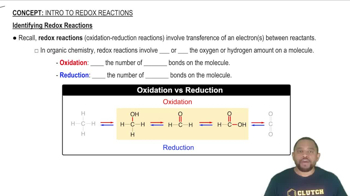
    In organic chemistry, redox reactions involve changes in the number of carbon-oxygen and carbon-hydrogen bonds within a molecule.
  • What characterizes oxidation in organic chemistry?

    Oxidation is characterized by an increase in the number of carbon-oxygen bonds in a molecule.
  • What characterizes reduction in organic chemistry?

    Reduction is characterized by an increase in the number of carbon-hydrogen bonds in a molecule.
  • Which functional groups are the main focus in organic redox reactions?

    The main focus is on alcohols, aldehydes, ketones, and carboxylic acids.
  • Why are hydrocarbons and carbon dioxide not the focus in organic redox reactions?

    They represent the extremes of oxidation and reduction and are not typically involved in organic transformations.
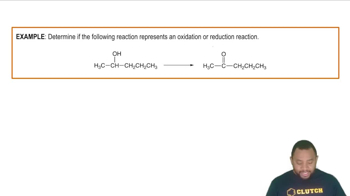
  • What happens to the number of carbon-oxygen bonds when an alcohol is oxidized to an aldehyde or ketone?

    The number of carbon-oxygen bonds increases from one to two.
  • What is the result of further oxidation of an aldehyde or ketone?

    Further oxidation produces a carboxylic acid, increasing the carbon-oxygen bonds to three.
  • What happens to the number of carbon-hydrogen bonds during reduction from carboxylic acid to alcohol?

    The number of carbon-hydrogen bonds increases as the molecule is reduced from carboxylic acid to alcohol.
  • What is the significance of the highlighted section between alcohols, aldehydes/ketones, and carboxylic acids?

    This section represents the intermediate stages of organic redox reactions, where functional group transformations occur.
  • What is the first oxidation step for a hydrocarbon in organic chemistry?

    The first oxidation step creates the first carbon-oxygen bond, forming an alcohol.
  • How does the number of carbon-hydrogen bonds change as a molecule is reduced?

    The number of carbon-hydrogen bonds increases with each reduction step.
  • What is the relationship between oxidation and the formation of carboxylic acids?

    Oxidation increases the number of carbon-oxygen bonds, ultimately forming carboxylic acids from alcohols or aldehydes/ketones.
  • Why is understanding redox reactions important in organic chemistry?

    It is crucial for grasping the mechanisms of organic transformations and synthesizing different organic compounds.
  • What is the main difference between redox reactions in general chemistry and organic chemistry?

    General chemistry focuses on electron transfer, while organic chemistry emphasizes changes in carbon-oxygen and carbon-hydrogen bonds.