Back

Intro to Radioactivity quiz

Control buttons has been changed to "navigation" mode.
1/15
  • What is radioactivity in terms of nuclear stability?

    Radioactivity is the spontaneous decomposition of an unstable nucleus due to an excess of neutrons or protons, resulting in the emission of radiation and formation of a new element.
  • How is the number of neutrons in an isotope calculated?

    The number of neutrons is found by subtracting the atomic number (Z) from the mass number (A): neutrons = A - Z.
  • What does the isotope notation X-A-Z represent?

    X is the element symbol, A is the mass number (protons + neutrons), and Z is the atomic number (number of protons).
  • What is the nuclear notation for a proton?

    A proton is represented as 1/1 p, where 1 is the mass number and 1 is the atomic number.
  • How is a neutron represented in nuclear notation?

    A neutron is written as 1/0 n, with a mass number of 1 and atomic number of 0.
  • What is the nuclear notation for an electron?

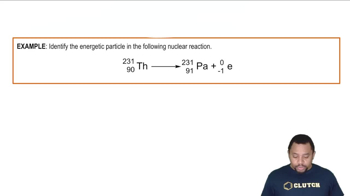
    An electron is represented as 0/-1 e, indicating a mass number of 0 and a charge of -1.
  • How is a positron different from an electron in nuclear notation?

    A positron is 0/+1 e, meaning it has the same mass as an electron but a positive charge.
  • What is the main difference between chemical and nuclear reactions?

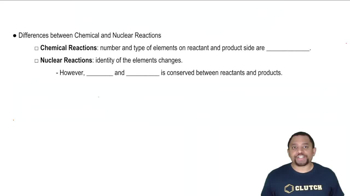
    Chemical reactions conserve the identity and number of each element, while nuclear reactions can change the identity of elements by altering the number of protons.
  • What is conserved in a nuclear reaction?

    The overall mass number and total number of protons are conserved between reactants and products in a nuclear reaction.
  • What is a parent nuclide in a nuclear reaction?

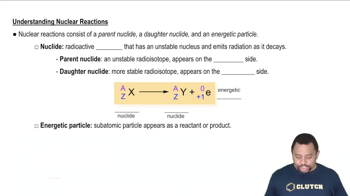
    The parent nuclide is the unstable radioactive isotope that appears on the reactant side and undergoes decay.
  • What is a daughter nuclide?

    A daughter nuclide is the more stable isotope produced as a product in a nuclear reaction.
  • What are the five main types of radioactivity?

    The five main types are alpha decay, beta decay, gamma emission, positron emission, and electron capture.
  • In which types of radioactivity is the energetic particle emitted as a product?

    In alpha decay, beta decay, gamma emission, and positron emission, the energetic particle is emitted as a product.
  • What is unique about electron capture compared to other types of radioactivity?

    In electron capture, the energetic particle (electron) is absorbed as a reactant rather than emitted as a product.
  • What does the term 'decay' or 'emission' mean in the context of radioactivity?

    Decay or emission refers to the process where an energetic particle is released from an unstable nucleus during radioactive transformation.