Back

Intro to Electrochemical Cells quiz

Control buttons has been changed to "navigation" mode.
1/15
  • What are the main components of an electrochemical cell?

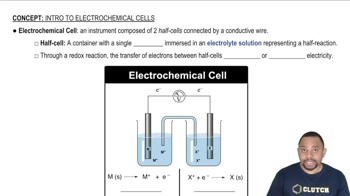
    An electrochemical cell consists of two half-cells, each with an electrode immersed in an electrolyte, connected by a conductive wire.
  • What is a half-cell in an electrochemical cell?

    A half-cell is a container with a single electrode immersed in an electrolyte solution, representing a half-reaction.
  • Where does oxidation occur in an electrochemical cell?

    Oxidation occurs at the electrode where electrons are lost, increasing the oxidation number.
  • What happens to the oxidation number during oxidation?

    The oxidation number increases during oxidation, indicating a loss of electrons.
  • Where does reduction occur in an electrochemical cell?

    Reduction occurs at the electrode where electrons are gained, decreasing the oxidation number.
  • What is the movement of electrons responsible for in an electrochemical cell?

    The movement of electrons between half-cells through a conductive wire produces or consumes electricity.
  • How is electricity generated in an electrochemical cell?

    Electricity is generated by the transfer of electrons from the oxidation half-cell to the reduction half-cell.
  • What is cell potential in an electrochemical cell?

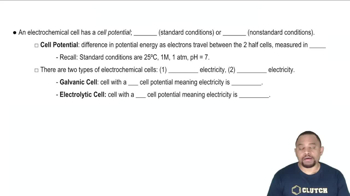
    Cell potential is the difference in potential energies as electrons travel between the half-cells, measured in volts (V).
  • What are standard conditions for measuring cell potential?

    Standard conditions are 25°C, 1 M concentration, 1 atm pressure, and pH 7.
  • How is standard cell potential denoted?

    Standard cell potential is denoted as E°cell, with a little circle or knot symbol.
  • What is the difference between standard and non-standard cell potential?

    Standard cell potential is measured under standard conditions, while non-standard cell potential is measured under other conditions.
  • What are the two types of electrochemical cells?

    The two types are galvanic cells, which produce electricity, and electrolytic cells, which consume electricity.
  • What is the cell potential of a galvanic cell?

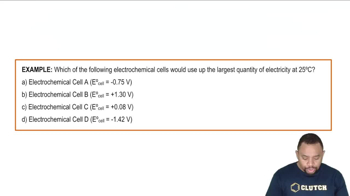
    A galvanic cell has a positive cell potential, indicating it produces electricity.
  • What is the cell potential of an electrolytic cell?

    An electrolytic cell has a negative cell potential, meaning it consumes electricity.
  • What is the role of the conductive wire in an electrochemical cell?

    The conductive wire connects the two half-cells and allows electrons to travel between them.