Back

Intro to Crystal Field Theory quiz

Control buttons has been changed to "navigation" mode.
1/15
  • What does crystal field theory aim to explain in transition metal coordination compounds?

    Crystal field theory explains the colors and magnetic properties of transition metal coordination compounds.
  • What creates the electric field around a metal cation in a coordination compound?

    Ligands surrounding the metal cation create the electric field.
  • How do ligands affect the energy of metal d orbitals?

    Ligands increase the energy of the metal d orbitals due to electrostatic repulsion between their electrons and those of the metal cation.
  • What is the main type of interaction between ligands and metal d orbitals in crystal field theory?

    The interaction is electrostatic, involving repulsion between electrons of the ligands and the metal cation.
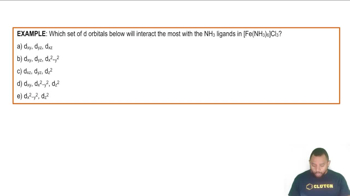
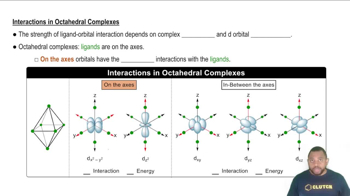
  • In an octahedral complex, which d orbitals experience the greatest increase in energy?

    The dx2-y2 and dz2 orbitals experience the greatest increase in energy because they are oriented along the axes where the ligands are located.
  • Why do the dx2-y2 and dz2 orbitals have higher energy in octahedral complexes?

    Because these orbitals are aligned along the axes and interact most strongly with the ligands.
  • Which d orbitals have lower energy in octahedral complexes and why?

    The dxy, dyz, and dxz orbitals have lower energy because they are oriented between the axes and interact less with the ligands.
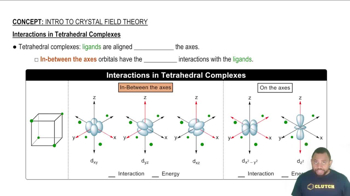
  • How are ligands arranged in a tetrahedral complex relative to the axes?

    In a tetrahedral complex, ligands are aligned between the axes.
  • Which d orbitals experience the greatest interaction with ligands in tetrahedral complexes?

    The dxy, dyz, and dxz orbitals experience the greatest interaction and energy increase in tetrahedral complexes.
  • Why do dx2-y2 and dz2 orbitals have lower energy in tetrahedral complexes?

    Because these orbitals are oriented along the axes, where there is less interaction with the ligands.
  • What determines the strength of ligand-d orbital interactions in coordination complexes?

    The geometry of the complex and the orientation of the d orbitals determine the strength of these interactions.
  • What is the effect of adding ligands to a metal cation on the d orbital energies?

    Adding ligands increases the energy of the metal cation's d orbitals due to increased electron repulsion.
  • What is ligand field theory and how is it related to crystal field theory?

    Ligand field theory combines crystal field theory with molecular orbital theory to explain bonding in coordination compounds.
  • How does crystal field theory account for the color of coordination compounds?

    Crystal field theory explains color by the splitting of d orbital energies, which allows for absorption of specific wavelengths of light.
  • What is the main difference in d orbital-ligand interactions between octahedral and tetrahedral complexes?

    In octahedral complexes, the greatest interaction is along the axes (dx2-y2 and dz2), while in tetrahedral complexes, it is between the axes (dxy, dyz, dxz).