What is chemical equilibrium in a chemical reaction?
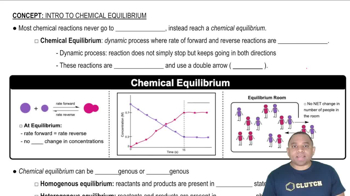
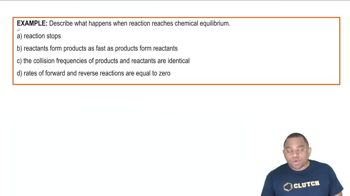
Chemical equilibrium is the state where the forward and reverse reactions occur at equal rates, resulting in no net change in the concentrations of reactants and products.
Why do most chemical reactions not go to completion?
Most reactions do not go to completion because they reach equilibrium, where both reactants and products are present and their concentrations remain constant over time.
What does it mean that chemical equilibrium is a dynamic process?
It means that the reaction continues to occur in both directions, with reactants turning into products and products turning back into reactants, even though concentrations remain unchanged.
How is a reversible reaction represented in a chemical equation?
A reversible reaction is represented by double arrows, indicating both the forward and reverse reactions.
At equilibrium, how do the rates of the forward and reverse reactions compare?
At equilibrium, the rate of the forward reaction equals the rate of the reverse reaction.
What happens to the concentrations of reactants and products at equilibrium?
The concentrations of reactants and products remain constant because the rates of their formation and consumption are equal.
How can the concept of equilibrium be illustrated using a party analogy?
It can be illustrated by people leaving and entering a party at the same rate, so the total number of people inside stays the same.
What is homogeneous equilibrium?
Homogeneous equilibrium occurs when all reactants and products are in the same phase, such as all gases or all aqueous solutions.
What is heterogeneous equilibrium?
Heterogeneous equilibrium involves reactants and products in different phases, such as a mixture of solids and gases.
What does the graph of reactant and product concentrations look like at equilibrium?
The graph shows the concentrations of reactants decreasing and products increasing until they both level off and remain constant at equilibrium.
Why is there no net change in the amount of reactants and products at equilibrium?
Because the amount lost in one direction is regained in the other, due to the equal rates of the forward and reverse reactions.
What does it mean for a reaction to be reversible?
A reversible reaction can proceed in both the forward and reverse directions, allowing products to reform reactants.
When does equilibrium occur during a reaction, according to the transcript's example?
Equilibrium occurs when the concentrations of reactants and products stop changing, such as at 15 seconds in the example graph.
How does the initial concentration of products change as a reaction approaches equilibrium?
Initially, the product concentration is zero and increases until equilibrium is reached, after which it remains constant.
Why is understanding chemical equilibrium important in chemistry?
It is important because many chemical processes depend on equilibrium, and not all reactions go to completion.
 Back
Back
 01:18
01:18