Back

Intro to Addition Reactions quiz

Control buttons has been changed to "navigation" mode.
1/15
  • What is an addition reaction in the context of alkenes and alkynes?

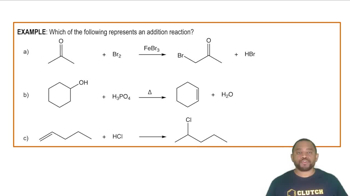
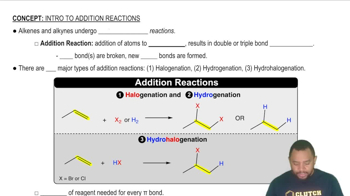
    An addition reaction is when atoms are added to pi bonds, causing double or triple bonds to break and new sigma bonds to form.
  • What happens to pi and sigma bonds during an addition reaction?

    Pi bonds are broken and new sigma bonds are formed during an addition reaction.
  • Name the three main types of addition reactions discussed for alkenes and alkynes.

    The three main types are halogenation, hydrogenation, and hydrohalogenation.
  • What is halogenation in the context of addition reactions?

    Halogenation is the addition of halogens to pi bonds, resulting in the formation of dihalides.
  • What is the product of halogenation of an alkene?

    The product is a dihalide, where two halogen atoms are added to the former alkene.
  • What is hydrogenation in addition reactions?

    Hydrogenation is the addition of hydrogen atoms to a pi bond, converting an alkene into an alkane.
  • What is the product of hydrogenation of an alkene?

    The product is an alkane, formed by adding hydrogen atoms to the alkene.
  • What is hydrohalogenation in addition reactions?

    Hydrohalogenation is the addition of a hydrogen and a halogen to an alkene, producing an alkyl halide.
  • What is the product of hydrohalogenation of an alkene?

    The product is an alkyl halide, where one hydrogen and one halogen are added to the alkene.
  • How many moles of reagent are needed for each pi bond in an addition reaction?

    One mole of reagent is needed for each pi bond present in the molecule.
  • How many moles of reagent are required to fully react with an alkyne (triple bond)?

    Two moles of reagent are required because a triple bond contains two pi bonds.
  • How many pi and sigma bonds are in a double bond?

    A double bond consists of one sigma bond and one pi bond.
  • How many pi and sigma bonds are in a triple bond?

    A triple bond consists of one sigma bond and two pi bonds.
  • Which bond type is always present in single, double, and triple bonds?

    The sigma bond is always present in all types of bonds.
  • What determines the number of moles of reagent needed in an addition reaction?

    The number of pi bonds in the molecule determines the number of moles of reagent needed.