Back

Intro to Acid-Base Titration Curves quiz

Control buttons has been changed to "navigation" mode.
1/15
  • What is the purpose of an acid-base titration?

    It is used to determine the unknown concentration of an acid or base by neutralizing it with a titrant of known concentration.
  • What is a titrant in an acid-base titration?

    A titrant is a strong acid or base solution with a known concentration that is added to the titrate.
  • Define titrate in the context of titration.

    A titrate is an acidic or basic solution with an unknown concentration being neutralized by the titrant.
  • What does a titration curve represent?

    A titration curve is a graph of the pH of the titrate during the titration as the titrant is added.
  • On a titration curve, what is typically plotted on the x-axis and y-axis?

    The x-axis shows the volume of titrant added, and the y-axis shows the pH of the solution.
  • What is the equivalence point in a titration?

    The equivalence point is where the moles of acid equal the moles of base, indicating complete neutralization.
  • Write the simplified equation used for stoichiometry at the equivalence point.

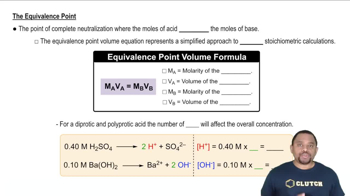
    The equation is MA × VA = MB × VB, where M is molarity and V is volume for acid (A) and base (B).
  • Why must you consider the number of H+ or OH- ions in polyprotic acids or bases during titration calculations?

    Because the total concentration of H+ or OH- ions affects the stoichiometry and must be multiplied by the number of acidic or basic ions present.
  • How do you calculate the true concentration of H+ ions in 0.40 M sulfuric acid (H2SO4)?

    Multiply the concentration by the number of acidic hydrogens: 0.40 M × 2 = 0.80 M H+.
  • How do you determine the true concentration of OH- ions in 0.10 M barium hydroxide (Ba(OH)2)?

    Multiply the concentration by the number of OH- ions: 0.10 M × 2 = 0.20 M OH-.
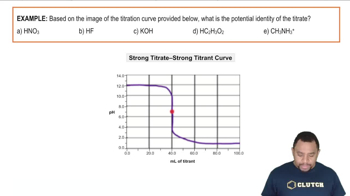
  • What is the typical shape of a titration curve when both the titrate and titrant are strong acids or bases?

    The curve is sigmoidal, resembling an S-shape.
  • What are the three key features of a strong acid-strong base titration curve?

    They are the pure titrate region (before titrant is added), the equivalence point (steepest incline), and the region after the equivalence point (excess titrant and plateau).
  • What happens to the pH as a strong base titrant is gradually added to a strong acid titrate?

    The pH increases gradually at first, then rises sharply near the equivalence point, and finally levels off after excess base is added.
  • Why is it important to use a strong titrant in typical acid-base titrations?

    A strong titrant ensures a clear and sharp equivalence point, making the titration curve easier to interpret.
  • What should you always check before using the equivalence point volume formula in titration calculations?

    You should check the number of H+ ions in the acid and the number of basic anions (like OH-) in the base to ensure correct stoichiometry.