Back

Instantaneous Rate quiz

Control buttons has been changed to "navigation" mode.
1/15
  • What is the instantaneous rate of a chemical reaction?

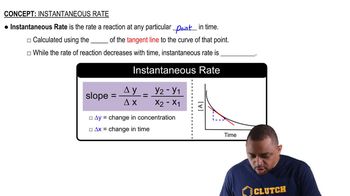
    It is the rate of a reaction at any particular point in time, determined by the slope of the tangent line to the concentration versus time curve at that point.
  • How do you calculate the instantaneous rate from a graph?

    You calculate it by finding the slope of the tangent line at the specific point on the concentration versus time graph.
  • What does the slope of the tangent line on a concentration vs. time graph represent?

    It represents the instantaneous rate of the reaction at that specific moment.
  • Why does the rate of reaction generally decrease over time?

    Because the amount of reactant decreases as the reaction proceeds, leading to a slower rate.
  • What formula is used to calculate the slope for instantaneous rate?

    The formula is (change in concentration) divided by (change in time), or Δconcentration/Δtime.
  • What do the variables y2, y1, x2, and x1 represent in the slope formula?

    y2 and y1 represent concentrations at two points, and x2 and x1 represent the corresponding times.
  • How many points are needed to determine the slope of a tangent line for instantaneous rate?

    Two points along the tangent line are needed to calculate the slope.
  • What is the significance of the instantaneous rate in reaction mechanisms?

    It helps predict how quickly a reaction will proceed at any given time, which is important for understanding reaction mechanisms.
  • Does the instantaneous rate remain constant during a reaction?

    No, it can change at different points in time as the reaction progresses.
  • What is the general trend of reaction rate as reactants are consumed?

    The reaction rate generally decreases as reactants are consumed.
  • What is meant by 'rise over run' in the context of instantaneous rate?

    'Rise over run' refers to the change in concentration (rise) over the change in time (run) between two points on the graph.
  • Why is the concept of instantaneous rate important in kinetics?

    Because it allows chemists to analyze and predict the speed of reactions at specific moments.
  • How is the tangent line related to the concentration vs. time curve?

    The tangent line touches the curve at only one point and its slope gives the instantaneous rate at that point.
  • What does Δconcentration/Δtime physically represent in a reaction?

    It represents how quickly the concentration of a reactant or product changes over a small time interval.
  • How can you use a graph to estimate the instantaneous rate if you don't have an equation?

    You can draw a tangent line at the point of interest and use two points on that line to calculate the slope.