Back

Heisenberg Uncertainty Principle quiz

Control buttons has been changed to "navigation" mode.
1/15
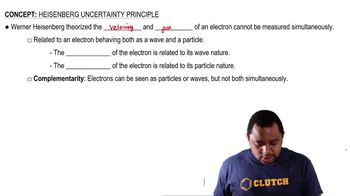
  • What does the Heisenberg uncertainty principle state about the velocity and position of an electron?

    It states that the velocity and position of an electron cannot be precisely determined at the same time.
  • Who formulated the uncertainty principle?

    Werner Heisenberg formulated the uncertainty principle.
  • What is the main reason we cannot know both the velocity and position of an electron simultaneously?

    It is due to the electron's dual wave-particle nature, known as complementarity.
  • How is the velocity of an electron related to its nature?

    The velocity of an electron is related to its wave nature.
  • How is the position of an electron related to its nature?

    The position of an electron is related to its particle nature.
  • What is the formula for the Heisenberg uncertainty principle?

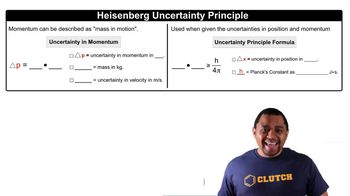
    The formula is ΔX⋅ΔP ≥ h/4π, where ΔX is uncertainty in position and ΔP is uncertainty in momentum.
  • What does ΔP represent in the uncertainty principle formula?

    ΔP represents the uncertainty in momentum, measured in kilograms times meters per second.
  • How can momentum be described in terms of mass and velocity?

    Momentum is described as mass in motion, or mass times velocity (m × v).
  • What is the value of Planck's constant (h)?

    Planck's constant is 6.626 × 10⁻³⁴ joule seconds.
  • What are the units of Planck's constant?

    The units are joules times seconds or kilograms times meters squared over seconds.
  • What does complementarity mean in the context of electrons?

    Complementarity means electrons can be seen as either particles or waves, but not both at the same time.
  • If you know the position of an electron very precisely, what happens to your knowledge of its velocity?

    Your knowledge of its velocity becomes very uncertain.
  • If you know the velocity of an electron very precisely, what happens to your knowledge of its position?

    Your knowledge of its position becomes very uncertain.
  • What is the significance of the uncertainty principle for subatomic particles?

    It sets a fundamental limit to how precisely we can know their properties.
  • How can the uncertainty in momentum (ΔP) be further expressed?

    It can be expressed as mass times the uncertainty in velocity (m × Δv).