Back

Enthalpy of Formation quiz

Control buttons has been changed to "navigation" mode.
1/15
  • What is the enthalpy change (ΔH) in thermochemistry commonly used to measure?

    ΔH measures the heat of reaction, indicating the energy change during a chemical reaction.
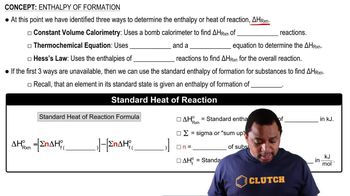
  • Name three methods to determine the enthalpy of reaction (ΔH) before using enthalpy of formation.

    The three methods are constant volume calorimetry, thermochemical equations with stoichiometry, and Hess's law.
  • What device is used in constant volume calorimetry to measure the enthalpy of reaction?

    A bomb calorimeter is used to measure the enthalpy of reaction, especially for combustion reactions.
  • How does Hess's law help in calculating the enthalpy of reaction?

    Hess's law uses the enthalpies of partial reactions to find the overall enthalpy change for a reaction.
  • What is the standard enthalpy of formation (ΔHf°) for an element in its standard state?

    The standard enthalpy of formation for an element in its standard state is zero.
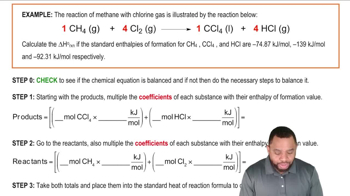
  • What formula is used to calculate the standard enthalpy of reaction (ΔH°rxn) using enthalpy of formation?

    ΔH°rxn = Σ(ΔHf° products) - Σ(ΔHf° reactants) is used to calculate the standard enthalpy of reaction.
  • What does the sigma (Σ) symbol represent in the enthalpy of reaction formula?

    The sigma symbol represents the summation, meaning to add up the enthalpies for all products or reactants.
  • What does the 'n' in the enthalpy of reaction formula stand for?

    The 'n' stands for the number of moles of each substance involved in the reaction.
  • What are the typical units for standard enthalpy of formation (ΔHf°)?

    The typical units are kilojoules per mole (kJ/mol) or sometimes joules per mole (J/mol).
  • Why is the standard enthalpy of formation method used when other methods are unavailable?

    It is used because it allows calculation of ΔH°rxn from tabulated values when direct measurement or Hess's law is not possible.
  • What does the small circle (°) in ΔHf° or ΔH°rxn indicate?

    The small circle indicates that the value is measured under standard conditions.
  • How do you find ΔH°rxn if you know the ΔHf° values for all reactants and products?

    Subtract the sum of ΔHf° values for reactants from the sum for products to get ΔH°rxn.
  • What is the significance of assigning ΔHf° = 0 to elements in their standard state?

    It provides a reference point for calculating enthalpy changes for compounds formed from these elements.
  • What is the simplest way to describe the standard heat of reaction formula?

    It is 'products minus reactants' using their standard enthalpies of formation.
  • What is the main purpose of using the standard enthalpy of formation in thermochemistry?

    It helps predict the energetics of reactions by calculating the heat change using known formation values.