Back

Electron Configurations of Transition Metals: Exceptions quiz

Control buttons has been changed to "navigation" mode.
1/15
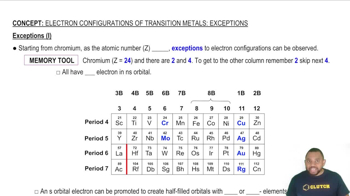
  • Which transition metal marks the start of electron configuration exceptions in the periodic table?

    Chromium, with atomic number 24, marks the start of these exceptions.
  • What is the typical electron configuration for chromium before considering exceptions?

    It is Argon 4s2 3d4 before the exception is applied.
  • How does the electron configuration of chromium change due to the exception?

    One electron from the 4s orbital is promoted to the 3d orbital, resulting in Argon 4s1 3d5.
  • What pattern helps identify transition metals with electron configuration exceptions?

    A 2-4 pattern: starting at chromium, skip the next 4, then the following 4 elements show exceptions.
  • What happens to d4 and d9 elements in terms of electron configuration exceptions?

    An s orbital electron is promoted, making d4 elements become d5 and d9 elements become d10.
  • Why are half-filled orbitals favored in these transition metal exceptions?

    Half-filled orbitals are more stable due to electron exchange energy and symmetry.
  • What is the electron configuration for chromium after the exception is applied?

    It becomes Argon 4s1 3d5.
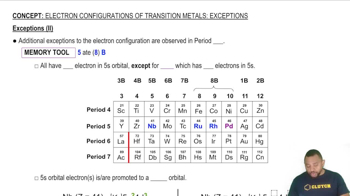
  • Which period 5 transition metals show electron configuration exceptions?

    Elements in groups 5B and 8B, such as niobium and palladium, show these exceptions.
  • What is unique about palladium’s electron configuration among period 5 exceptions?

    Palladium has zero electrons in its 5s orbital, unlike the others which have one.
  • What is the initial electron configuration for niobium before considering exceptions?

    It is Krypton 5s2 4d3.
  • How does niobium’s electron configuration change due to the exception?

    One electron from the 5s orbital is promoted to the 4d orbital, resulting in 5s1 4d4.
  • What memory tool is used to recall period 5 transition metal exceptions?

    The numbers 5 and 8, referring to groups 5B and 8B, help identify these exceptions.
  • What is the electron configuration for palladium after the exception is applied?

    Palladium has no electrons in its 5s orbital; all are in the 4d orbital.
  • What rule is followed when filling the d orbitals after electron promotion in transition metals?

    Hund’s rule is followed, which states electrons fill orbitals singly before pairing.
  • Why do transition metals promote an s orbital electron to the d orbital in these exceptions?

    Promotion creates more stable, half-filled or fully-filled d orbitals.