Back

Diprotic Acids and Bases Calculations quiz

Control buttons has been changed to "navigation" mode.
1/15
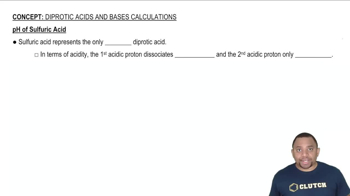
  • What is the only strong diprotic acid commonly discussed in general chemistry?

    Sulfuric acid (H2SO4) is the only strong diprotic acid.
  • How does the first acidic proton of sulfuric acid behave in water?

    The first acidic proton dissociates completely in water.
  • What ion is formed when sulfuric acid loses its first proton?

    HSO4⁻ (hydrogen sulfate ion) is formed.
  • What is the behavior of the second acidic proton in sulfuric acid?

    The second acidic proton dissociates only partially, making it a weak acid in this step.
  • What type of arrow is used to represent the first dissociation of sulfuric acid?

    A solid arrow is used, indicating complete dissociation.
  • What type of arrow is used for the second dissociation of sulfuric acid?

    Reversible arrows are used, indicating partial dissociation.
  • What is the product when HSO4⁻ reacts with water in the second dissociation step?

    SO4²⁻ (sulfate ion) and H3O⁺ (hydronium ion) are formed.
  • What are K1 and K2 in the context of diprotic acids?

    K1 is the dissociation constant for the first proton, and K2 is for the second proton.
  • Why is K1 larger than K2 for sulfuric acid?

    K1 represents strong acid dissociation (complete), while K2 is weaker (partial dissociation).
  • Why is it important to consider both acidic protons when calculating pH for diprotic acids?

    Both protons contribute to the total H⁺ ion concentration, affecting pH calculations.
  • What is the chemical equation for the first dissociation of sulfuric acid in water?

    H2SO4 (aq) + H2O (l) → HSO4⁻ (aq) + H3O⁺ (aq).
  • What is the chemical equation for the second dissociation of sulfuric acid in water?

    HSO4⁻ (aq) + H2O (l) ⇌ SO4²⁻ (aq) + H3O⁺ (aq).
  • How does the second dissociation of sulfuric acid affect the concentration of H⁺ ions?

    It increases the H⁺ ion concentration, but only partially due to incomplete dissociation.
  • What distinguishes sulfuric acid from other diprotic acids?

    Sulfuric acid is the only strong diprotic acid; others are weak.
  • What is the significance of reversible arrows in acid dissociation equations?

    They indicate that the reaction is not complete and only some reactants convert to products.